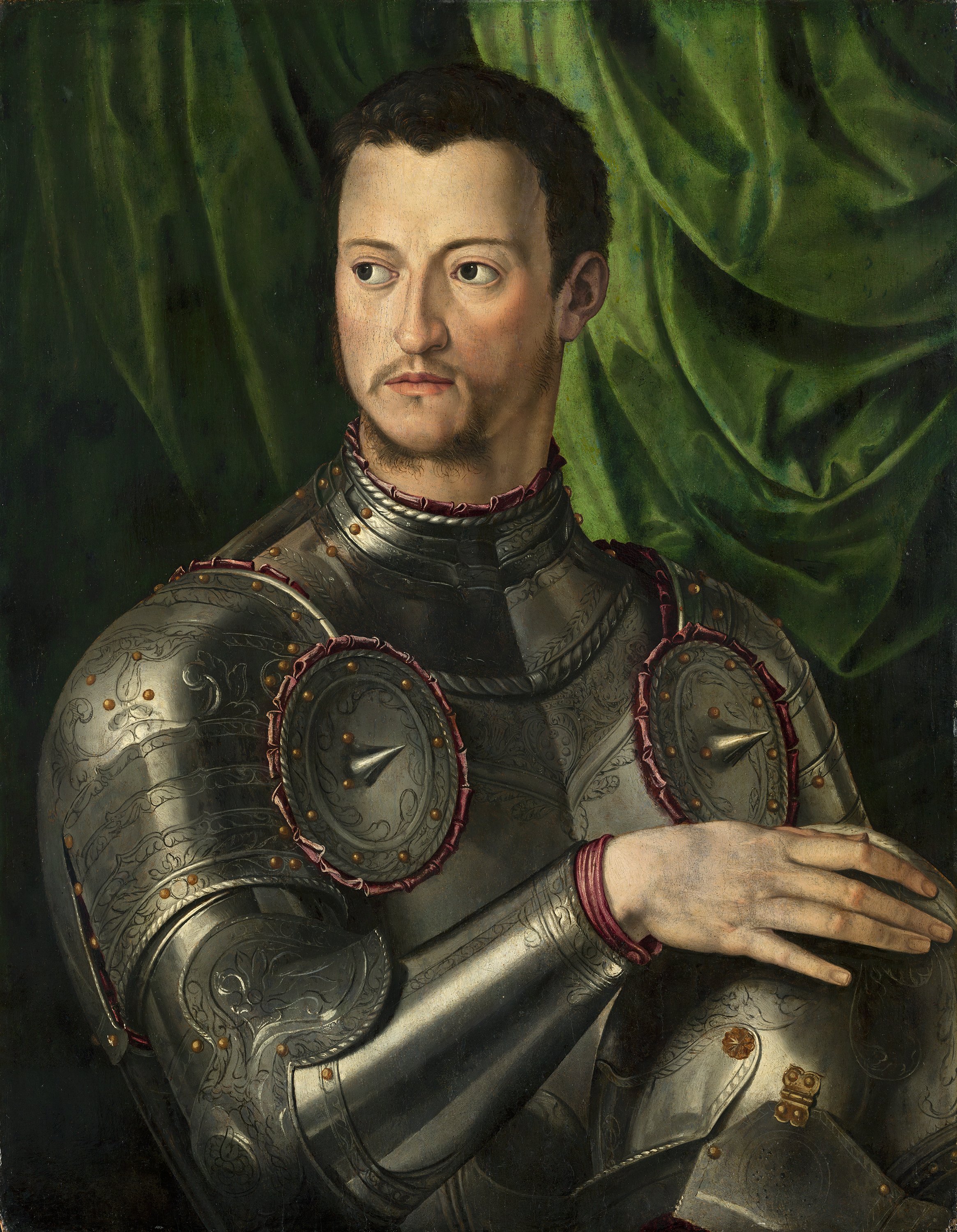
Born in 1389 in Florence, Cosimo di Giovanni de’ Medici rose from a prominent banking family to become the city’s dominant political figure and one of the foremost patrons of early Renaissance art and learning. According to Encyclopaedia Britannica, he is commonly listed as born on September 27, 1389, and died on August 1, 1464, at Careggi near Florence, while Italian scholarship notes a documentary birth date of April 10, 1389, with Cosimo celebrating his name day on September 27 (feast of Saints Cosmas and Damian). Encyclopaedia Britannica;
Treccani, Dizionario Biografico degli Italiani.
Family, early career, and banking
Cosimo was the elder son of Giovanni di Bicci de’ Medici, founder of the Medici Bank, and Piccarda Bueri; he was trained in high finance and first gained experience representing the bank at major ecclesiastical gatherings. Encyclopaedia Britannica;
Treccani, Enciclopedia Italiana.
Britannica notes that Cosimo managed papal finances and, in 1462, secured rights connected with alum from Tolfa under Pope Pius II—an indispensable mordant for Florence’s textile industry—augmenting his vast wealth and influence. Encyclopaedia Britannica.
Contemporary scholarship shows the papal alum monopoly was structured through the Camera Apostolica, with large Medici purchases documented in 1463–1464, underscoring the family’s deep involvement in the trade. Mélanges de l’École française de Rome – Moyen Âge.
On the organization and reach of the Medici Bank—its branches, practices, and rise in the 15th century—see Raymond de Roover’s classic study. [The Rise and Decline of the Medici Bank 1397–1494](book://Raymond de Roover|The Rise and Decline of the Medici Bank, 1397–1494|Harvard University Press|1963).
Exile (1433) and return (1434)
Cosimo’s growing prominence provoked the Albizzi-led oligarchy: he was arrested in 1433 on charges of seeking to elevate himself above fellow citizens and was sentenced to exile, which he spent mainly in Padua and Venice. Encyclopaedia Britannica;
Treccani, Dizionario di Storia.
In 1434, a favorable electoral outcome restored Medici influence, and Cosimo returned in triumph, while many of his opponents—among them Palla Strozzi—were excluded from office or exiled. Encyclopaedia Britannica;
Treccani, Enciclopedia on line.
Governance and diplomacy
After 1434 Cosimo maintained republican forms while ensuring that offices were filled by loyalists, a process sustained through controlled electoral mechanisms; in 1458 he created the Council of the Hundred (Cento), consolidating Medici ascendancy. Encyclopaedia Britannica;
Treccani, Dizionario di Storia.
He forged a strategic alliance with Francesco Sforza of Milan, which underpinned Florentine security and helped shape the balance of power; Britannica credits Cosimo as an architect of the Peace of Lodi (1454) that inaugurated decades of relative stability in the peninsula. Encyclopaedia Britannica;
Britannica, Peace of Lodi.
Cosimo’s greatest diplomatic coup was enticing the ecumenical council from Ferrara to Florence in 1439, where a short-lived union between Latin and Greek Churches was proclaimed (Laetentur Caeli), elevating Florence’s international standing. Britannica, Council of Ferrara–Florence;
Encyclopaedia Britannica.
Patronage of art and architecture
Cosimo’s patronage transformed the city’s built environment and arts. He commissioned architect Michelozzo di Bartolomeo to design the family palace—today Palazzo Medici Riccardi—with work begun in 1444; Michelozzo’s scheme prevailed over a more grandiose proposal attributed to Filippo Brunelleschi, reflecting Cosimo’s preference for dignified restraint. Palazzo Medici Riccardi – The Palace.
Under Cosimo’s patronage, Michelozzo rebuilt the Dominican convent of San Marco (1437–1443), including its celebrated library, and the complex now houses the world’s largest collection of works by Fra Angelico. Museo di San Marco – Ministero della cultura;
Museo di San Marco – Ministero della cultura.
Cosimo also supported leading masters of the age—among them Donatello, Lorenzo Ghiberti, Andrea del Castagno, and Benozzo Gozzoli—assuring them steady commissions and elevating their social status in Florence. Encyclopaedia Britannica.
San Lorenzo, the Medici parish church, became a principal focus of patronage: Brunelleschi designed the basilica and the Old Sacristy, with Donatello contributing its sculptural program; subsequently, Cosimo was interred at San Lorenzo, where his tomb slab and crypt are integral to the church fabric. Britannica, San Lorenzo;
Web Gallery of Art.
Humanism, libraries, and the Platonic current
Cosimo organized systematic searches for classical manuscripts and opened collections for scholarly use, notably at San Marco, expanding access to Greek and Latin texts for friars and lay scholars alike. Encyclopaedia Britannica;
Museo di San Marco – blog note on Michelozzo’s “public library”.
He fostered the revival of Platonism in Florence, supporting Marsilio Ficino, to whom he gave a property at Careggi (1463) and with whom he cultivated an informal “Platonic Academy,” a network of humanists who read and discussed Plato and related texts. Stanford Encyclopedia of Philosophy – Marsilio Ficino.
The transfer of the Council of Florence to the city in 1439 exposed Florentine elites to Greek scholars and texts, reinforcing the humanist program that Cosimo favored and linking classical learning with civic life. Britannica, Council of Ferrara–Florence.
Death, burial, and honorific
Cosimo died on August 1, 1464, at the Medici villa in Careggi and was buried at San Lorenzo, where an inscription in the pavement before the high altar proclaims him Pater Patriae by public decree. Encyclopaedia Britannica;
Web Gallery of Art.
The San Lorenzo complex—basilica, chapels, and crypt—remains closely tied to Medici history; the Opera Medicea Laurenziana preserves and interprets the site’s layered development from the early 15th century onward. Opera Medicea Laurenziana.
Legacy and succession
Cosimo’s political methods—managing elections, rewarding adherents, and neutralizing adversaries—ensured continuity of Medici leadership while maintaining republican forms, a pattern noted by both Italian and English-language scholarship. Treccani, Dizionario di Storia;
Encyclopaedia Britannica.
He was succeeded by his son Piero di Cosimo de’ Medici (Piero “the Gouty”), with the dynasty’s cultural zenith arriving under Cosimo’s grandson Lorenzo de’ Medici; together their era defined Florentine preeminence in art, letters, and finance. Encyclopaedia Britannica – Piero di Cosimo de’ Medici;
Encyclopaedia Britannica.