Introduction
Holography is a method of recording and reconstructing light fields to produce three-dimensional images. Unlike traditional photography, which captures only the intensity of light, holography records both the intensity and phase of light waves, allowing for the recreation of the original light field. This process relies on the principles of interference and diffraction.
History
The concept of holography was introduced by physicist Dennis Gabor in 1948 while he was attempting to improve the resolution of electron microscopes. Gabor's work laid the foundation for holography, earning him the Nobel Prize in Physics in 1971. The development of the laser in the 1960s provided the coherent light sources necessary for practical holography, leading to significant advancements in the field.
Principles of Holography
Recording Process
In holography, a coherent light source, typically a laser, is split into two beams: the object beam and the reference beam. The object beam illuminates the subject, and the light scattered from the object combines with the reference beam on a recording medium, creating an interference pattern. This pattern encodes the amplitude and phase information of the light waves.
Reconstruction Process
To reconstruct the image, the recorded hologram is illuminated with the reference beam. The diffraction of light through the interference pattern recreates the original light field, producing a three-dimensional image that can be viewed without special glasses.
Applications
Data Storage
Holographic data storage utilizes the volume of recording media to store data in three dimensions, potentially offering higher storage capacities compared to traditional two-dimensional methods. This technology is being explored for its potential to revolutionize data storage solutions. Source
Security Features
Holograms are widely used as security features on banknotes, credit cards, and identification documents. Their complex patterns are difficult to replicate, providing an effective measure against counterfeiting. Source
Microscopy
Holographic microscopy allows for the imaging of transparent and phase objects, such as biological cells, without the need for staining. This technique provides detailed, depth-resolved images, enhancing the study of microscopic structures. Source
Art
Artists have embraced holography to create three-dimensional artworks that change appearance based on the viewer's perspective. This medium offers unique visual experiences and has been exhibited in various art galleries worldwide. Source
Computer-Generated Holography
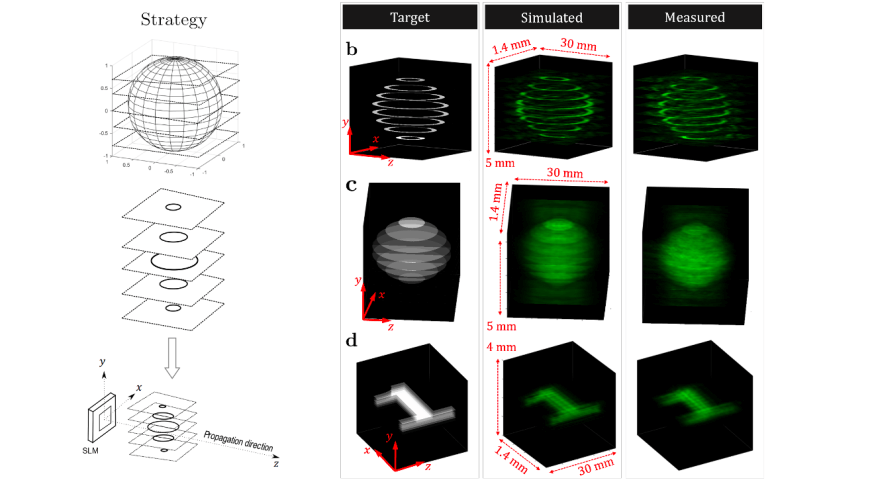
Advancements in computing have led to the development of computer-generated holography (CGH), where holograms are created digitally without the need for physical objects. CGH involves complex calculations to simulate the interference patterns that would be produced by real objects, enabling the display of virtual three-dimensional images. Source
Limitations and Challenges
Despite its potential, holography faces challenges such as the need for coherent light sources, sensitivity to vibrations during recording, and the complexity of producing and displaying holograms. Additionally, the computational demands of CGH are significant, requiring advanced algorithms and processing power. Source
Conclusion
Holography represents a significant advancement in imaging technology, offering the ability to record and reconstruct three-dimensional light fields. Its applications span various fields, including data storage, security, microscopy, and art. Ongoing research and technological developments continue to address its challenges, expanding the potential uses of holography in the future.