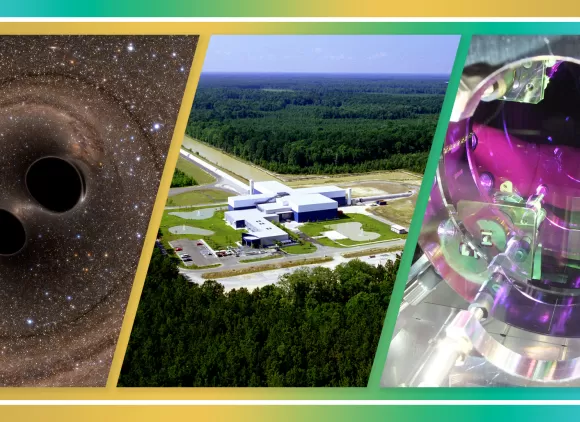
Overview
LIGO is a ground-based gravitational-wave observatory comprising twin 4-kilometer interferometers in Hanford, Washington, and Livingston, Louisiana, designed and operated by the California Institute of Technology and the Massachusetts Institute of Technology with core funding from the U.S. National Science Foundation. According to the LIGO Laboratory, the facility’s mission is to operate the detectors, improve their capabilities, and enable broad scientific participation in gravitational-wave research. LIGO Lab;
Mission, LIGO Lab.
LIGO performs precision measurements of spacetime strain produced by astrophysical sources predicted by Albert Einstein’s general theory of relativity, using laser interferometry to sense length changes many orders of magnitude smaller than an atomic nucleus. LIGO Lab;
Advanced LIGO (design).
Facilities and instrumentation
LIGO consists of two identical L-shaped observatories with 4 km arms located near Hanford, Washington (LHO), and Livingston, Louisiana (LLO), an architecture that enables coincident detections and sky localization. Facilities, LIGO Lab.
Each detector is a dual-recycled Fabry–Perot Michelson interferometer that uses 1064 nm laser light, power recycling, and signal recycling to enhance sensitivity across the audio band. Advanced LIGO (design);
LIGO’s Laser.
The interferometers employ 40 kg fused-silica “test mass” mirrors polished and coated to extreme optical quality and suspended as the final stage of a quadruple-pendulum system to isolate them from ground motion. LIGO Optics;
Seismic Isolation and Suspensions.
To minimize gas-phase and particulate noise, each 4 km arm is housed in a 1.2 m-diameter ultra–high-vacuum beam tube engineered to withstand atmospheric load over decades of operation. Ultra-High Vacuum, LIGO Lab.
Development and governance
The LIGO project originated from interferometric concepts articulated by Rainer Weiss in the early 1970s and later advanced by a collaboration that included Kip S. Thorne and Barry C. Barish, with construction of the initial facilities completed in 1999 and operations of “Initial LIGO” commencing in the 2000s. Weiss 1972 report (LIGO DCC);
Inauguration of LIGO facility (1999), Caltech;
Timeline, LIGO Lab.
The upgrade to “Advanced LIGO,” funded by the NSF and international partners, replaced core subsystems and improved design strain sensitivity by an order of magnitude, enabling routine detections. Advanced LIGO (design);
NSF news on A+ funding;
Caltech news on A+ funding.
LIGO is operated by Caltech and MIT as the LIGO Laboratory and functions as a national user facility supported by the NSF, in collaboration with the LIGO Scientific Collaboration (LSC). LIGO Lab;
Mission, LIGO Lab.
Observing runs and performance
Advanced LIGO’s first observing run (O1) began in September 2015, followed by O2 in 2016–2017 and O3 in 2019–2020, with observing interleaved with commissioning and upgrades. Timeline, LIGO Lab.
The fourth observing run (O4) began on May 24, 2023; following a mid-run break and commissioning, LVK operations resumed on June 11, 2025, with O4 scheduled to conclude on November 18, 2025. IGWN Observing Plans;
Timeline, LIGO Lab.
During O4, the detectors achieved angle-averaged binary-neutron-star (BNS) ranges on the order of 150–177 Mpc depending on epoch and site, with typical O4 BNS range targets of about 160–190 Mpc for LIGO. Advanced LIGO performance in O4;
NASA GCN LVK page.
On March 19, 2025, LIGO reported reaching 200 cumulative gravitational-wave detections across its observing history, reflecting the increased sensitivity and duty cycle of the network. Timeline, LIGO Lab.
Landmark detections
LIGO made the first direct detection of gravitational waves on September 14, 2015, observing GW150914 from the merger of two stellar-mass black holes, as reported in Physical Review Letters in February 2016. PRL: Observation of Gravitational Waves from a Binary Black Hole Merger.
On August 17, 2017, LIGO and Virgo detected GW170817, the first binary neutron star inspiral observed in gravitational waves, accompanied by a short gamma-ray burst and a kilonova across the electromagnetic spectrum, establishing multi-messenger astronomy with gravitational waves. PRL: GW170817;
LVC ApJL multi-messenger paper (LIGO DCC).
For its decisive contributions to the LIGO detectors and the observation of gravitational waves, the 2017 Nobel Prize in Physics was awarded to Rainer Weiss, Barry C. Barish, and Kip S. Thorne. Nobel Prize press release.
Upgrades and key technologies
The Advanced LIGO configuration integrates Fabry–Perot arm cavities, power recycling, and signal recycling to sculpt frequency response, while high-power, frequency- and power-stabilized 1064 nm lasers provide the photon statistics needed to reduce shot noise. Advanced LIGO (design);
LIGO’s Laser.
To suppress thermal noise and radiation-pressure effects, LIGO uses 40 kg fused-silica test masses with low-loss optical coatings and quadruple-pendulum suspensions, complemented by active and passive seismic isolation. LIGO Optics;
Seismic Isolation and Suspensions.
As part of the “A+” upgrade program implemented for O4, LIGO introduced 300 m filter cavities to realize frequency-dependent squeezed light, reducing both high-frequency shot noise and low-frequency quantum backaction and thereby delivering broadband quantum noise reduction of several decibels. PRX: Frequency-Dependent Squeezing (2023);
Advanced LIGO performance in O4.
Global detector network
LIGO conducts observations in coordination with the 3 km Virgo interferometer near Pisa, Italy, and the 3 km KAGRA detector in Japan, forming the LVK network to improve sky localization and source characterization. Virgo detector overview;
NASA GCN LVK page.
An additional 4 km LIGO facility is under development in India, following final governmental approvals in April 2023, with civil construction activities initiated toward an expected completion later this decade; LIGO-India is a partnership among Indian agencies and the LIGO Laboratory. Caltech news: India approves LIGO-India;
LIGO-India (official site);
Indian Express (project schedule).
Data, alerts, and community use
During observing runs, event candidates are disseminated to the astronomy community through low-latency public alerts and circulars to enable electromagnetic and neutrino follow-up. NASA GCN LVK page.
LIGO operates as a national facility; data releases, software, and publications are produced through the LIGO Scientific Collaboration and in concert with Virgo and KAGRA. LIGO Lab;
Virgo Collaboration overview.
Future directions
Planned detector evolution includes further reduction of quantum and thermal noises (e.g., enhanced squeezing, higher-power lasers, upgraded suspensions and coatings) within the A+ program and beyond. Advanced LIGO performance in O4;
NSF news on A+ funding.
Third-generation ground-based observatories now in planning—such as the U.S. Cosmic Explorer concept with 20–40 km arms and Europe’s underground Einstein Telescope—aim to extend the detection horizon by an order of magnitude and access new source populations across cosmic time. Cosmic Explorer (official site);
Einstein Telescope (official site).