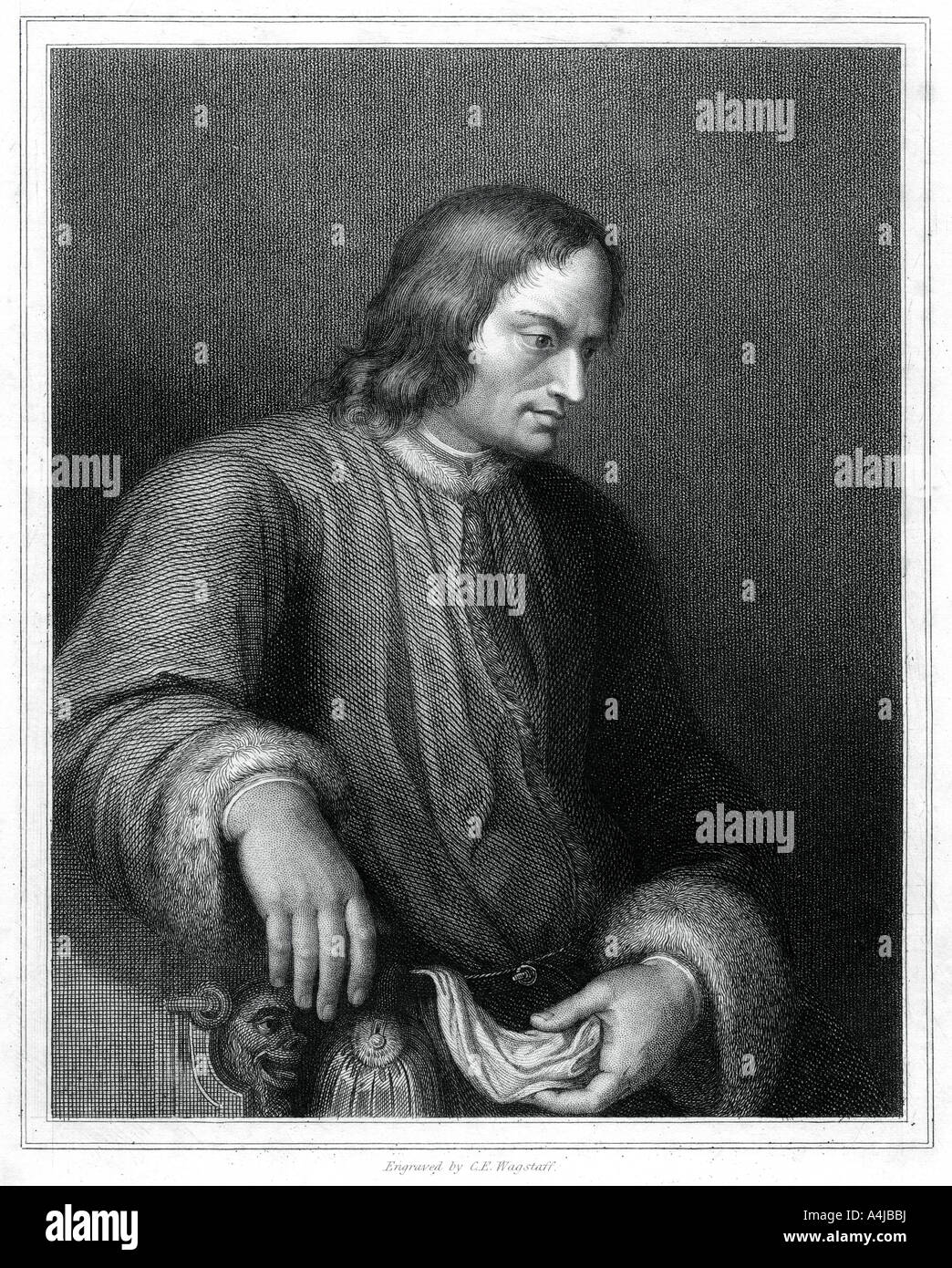
Lorenzo de' Medici (born 1 January 1449 in Florence, died 9 April 1492 at Careggi) was an Italian statesman, banker, poet, and de facto head of the Medici house whose patronage and diplomacy shaped the Florentine Renaissance, according to the Editors of Encyclopaedia Britannica.
Family and early life
Lorenzo was the son of Piero di Cosimo de' Medici and Lucrezia Tornabuoni and grandson of Cosimo de' Medici; he entered Florentine political bodies in his teens, including the balìa and the Consiglio dei Cento in 1466, as noted by the entry in the Enciclopedia Italiana Treccani. He married Clarice Orsini in 1469, forging ties with prominent Roman nobility, as recorded by
Treccani. Upon the death of his father in December 1469, he assumed leadership of Florence while formally remaining a private citizen, a dynamic emphasized by
Treccani and summarized by
Britannica.
Governance and institutions
Contemporaries and later historians described Lorenzo’s regime as that of a “benevolent tyrant” operating within a republican framework; he strengthened Medicean control through institutional adjustments, including creation of a Council of Seventy to supersede older councils, as detailed by Britannica. His approach balanced pageantry—festivals, tournaments, and civic spectacle—with carefully managed oligarchic consent, according to
Britannica and the Machiavellian perspective summarized in
Treccani’s Enciclopedia machiavelliana.
The Pazzi Conspiracy and war (1478–1480)
On 26 April 1478, members of the Pazzi family and their allies attacked Lorenzo and his brother Giuliano during High Mass in the cathedral; Giuliano was killed, and Lorenzo escaped with minor wounds, events reconstructed by Encyclopaedia Britannica and the Lorenzo biography at
Britannica. The failed coup triggered a papal-Florentine war; Pope Sixtus IV and King Ferrante (Ferdinand I) of Naples pressed Florence, whereupon Lorenzo personally traveled to Naples (December 1479–March 1480) and negotiated a settlement that isolated the papacy, as reported by
Treccani and distilled by
Britannica. The episode consolidated Lorenzo’s position and strengthened his image as the “needle on the Italian scales,” per
Britannica. These events are central to any account of the Pazzi Conspiracy, the most dramatic domestic challenge to Medicean rule, per
Britannica.
Diplomacy and the Italian balance of power
Through the 1480s, Lorenzo cultivated alliances with Italian states (notably Naples, Milan, and regional powers) and pursued territorial adjustments (e.g., acquisitions such as Pietrasanta and Sarzana) that reinforced Florence’s strategic position, a policy profile traced by Treccani. He participated in broader Italian conflicts—such as the War of Ferrara (1482–1484)—while maintaining Florentine equilibrium and prestige, as outlined by
Treccani and contextualized in the scholarship of John M. Najemy (book://John M. Najemy|A History of Florence 1200–1575|Blackwell|2006).
Patronage, humanism, and artistic circles
Lorenzo’s villas at Careggi, Fiesole, and Poggio a Caiano hosted a circle often called the “Platonic Academy,” centered on Marsilio Ficino with figures such as Angelo Poliziano and Giovanni Pico della Mirandola, a milieu described by Britannica. Artists he supported or advanced included Giuliano da Sangallo, Sandro Botticelli, Andrea del Verrocchio, and Leonardo da Vinci; his household treated artists with unusual familiarity, according to
Britannica. Toward the end of his life he established a sculpture garden near San Marco, where a teenage Michelangelo came to his notice; Lorenzo brought the youth into his palace, a formative episode summarized by
Britannica’s Michelangelo entry and the Lorenzo biography at
Britannica. Michelangelo’s earliest reliefs—Madonna della Scala and Battle of the Centaurs—now in Casa Buonarroti, are documented by the museum’s own descriptions (
Casa Buonarroti: Madonna della Scala and
Casa Buonarroti itinerary).
Literary work
Beyond patronage, Lorenzo wrote extensively in Tuscan on themes ranging from love to civic festivity; works include the Canti carnascialeschi (e.g., “Trionfo di Bacco e Arianna”), Nencia da Barberino, and Selve d’amore, with his literary activity closely tied to humanist discourse, as synthesized by Treccani. His cultivation of Tuscan vernacular alongside Latin is highlighted in
Treccani and echoed by
Britannica.
Finance and the Medici bank
Under Lorenzo the Medici bank’s profitability declined amid wider European competition and managerial failures in key branches. The London, Bruges, and Lyon branches became insolvent in the 1470s–1480s, a pattern summarized by Britannica. Classic financial history by Raymond de Roover analyzes these failures—especially Tommaso Portinari’s Bruges management and royal-credit exposure—as structural causes of the bank’s collapse (book://Raymond de Roover|The Rise and Decline of the Medici Bank: 1397–1494|Harvard University Press|1963). While Lorenzo’s largesse strained family resources, allegations that he subsidized the bank with public funds are not supported by evidence, as stated by
Britannica and assessed in de Roover’s study (book://Raymond de Roover|The Rise and Decline of the Medici Bank: 1397–1494|Harvard University Press|1963).
Household, alliances, and church politics
Dynastic marriages and ecclesiastical preferment anchored Lorenzo’s strategies: his marriage to Clarice Orsini linked Florence to Roman baronial networks; a daughter, Maddalena, married Franceschetto Cybo, the son of Pope Innocent VIII; and at age 13 his son Giovanni received a cardinal’s hat from Innocent VIII, facts reported by Britannica. After Giuliano’s murder in 1478, Giulio de’ Medici (the future Pope Clement VII), an illegitimate son of Giuliano, was reared in Lorenzo’s household, per
Britannica’s Clement VII entry. These arrangements illustrate the interweaving of Florentine and curial politics that characterized his leadership, as discussed in Najemy’s synthesis (book://John M. Najemy|A History of Florence 1200–1575|Blackwell|2006).
Religion and reformers
In 1490 Lorenzo, on the recommendation of Pico della Mirandola, permitted the Dominican friar Girolamo Savonarola to preach in Florence; Savonarola’s later denunciations of Medici worldliness and prophecy of imminent judgment gained traction as Lorenzo’s health waned, according to Britannica. A later tradition holds that Savonarola demanded political concessions at Lorenzo’s deathbed, but the historicity of that exchange is doubtful, a caution noted by
Britannica.
Death, burial, and immediate aftermath
Lorenzo died on 9 April 1492 at the villa in Careggi, aged 43, and was buried in San Lorenzo; his modest tombstone stands apart from Michelangelo’s later monuments to Medici kinsmen in the New Sacristy, as described by Britannica. Within two years, a republican movement allied with Savonarola expelled the Medici from Florence (1494), placing Lorenzo’s son Piero in exile and interrupting Medicean dominance until 1512, a political sequence framed in
Britannica and broader Florentine histories (book://John M. Najemy|A History of Florence 1200–1575|Blackwell|2006).
Assessment and historiography
Early modern authors such as Francesco Guicciardini and Niccolò Machiavelli offered contrasting profiles of Lorenzo as a prudent “prince” within a republic versus a master of oligarchic control; modern scholarship similarly balances his cultural achievements with recognition of tightened political structures, as surveyed in Treccani’s Enciclopedia machiavelliana and summarized by
Britannica. His cultural program—rooted in humanist sociability, vernacular literature, and artist patronage—made Florence a model of late Quattrocento civic culture, while his finance and statecraft navigated, but could not resolve, shifting Italian power politics, a synthesis consistent with de Roover’s financial analysis (book://Raymond de Roover|The Rise and Decline of the Medici Bank: 1397–1494|Harvard University Press|1963) and Najemy’s political history (book://John M. Najemy|A History of Florence 1200–1575|Blackwell|2006).