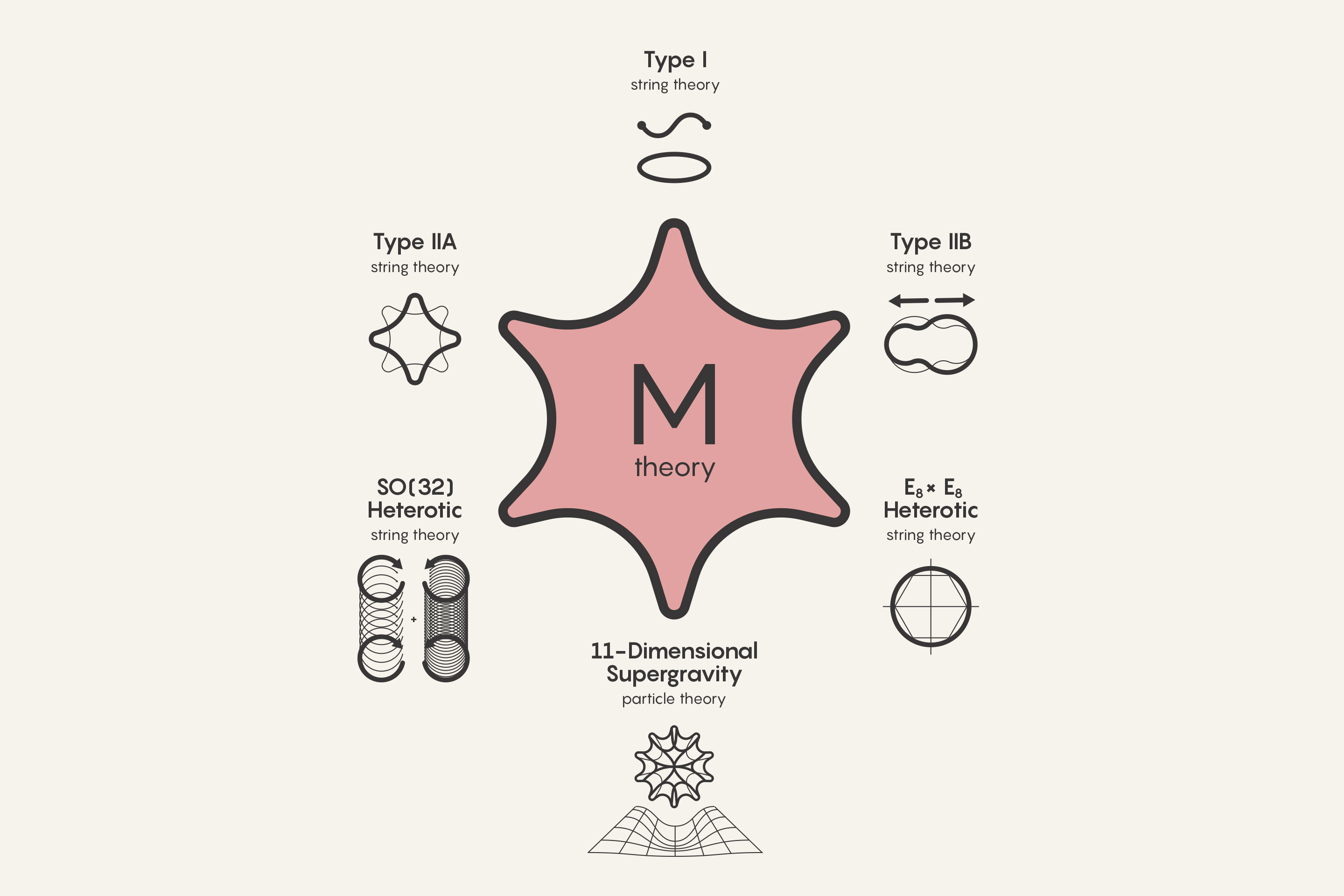
M-theory is a theoretical framework in high-energy physics proposing a unification of all consistent versions of Superstring theory through dualities, with an eleven-dimensional low-energy limit given by Eleven-dimensional supergravity. The proposal, attributed to Edward Witten in 1995, integrated prior insights about strong–weak and geometric dualities across string models and reframed extended objects—branes—as central ingredients of the theory. According to Encyclopaedia Britannica and Witten’s seminal analysis, M-theory subsumes Type I, Type IIA, Type IIB, heterotic SO(32), and heterotic E8×E8 superstrings within a single underlying structure. (
britannica.com)
History and proposal
- –In March 1995 (Strings ’95, University of Southern California), Witten argued that the five superstring theories are different limits of an eleven-dimensional framework, now called “M-theory.” This perspective drew on emerging evidence for S- and T-dualities and on the relation between Type IIA string theory at strong coupling and eleven-dimensional supergravity, as set out in [Edward Witten’s](book://Edward Witten|String Theory Dynamics in Various Dimensions|Nuclear Physics B|1995) paper and supporting reviews by others. Contemporary accounts and later profiles document the 1995 announcement and its role in the “second superstring revolution.” See
Witten 1995 (arXiv), the
Britannica string theory overview, and journalistic coverage in the New Yorker’s “Unstrung.” (
Foundational ingredients and dimensionality
- –M-theory is expected to be eleven-dimensional at low energies, reproducing the field content of Cremmer–Julia–Scherk eleven-dimensional supergravity (graviton, gravitino, and a 3-form). Witten’s strong-coupling analysis related the Type IIA string to an eleventh dimension, while work by Bergshoeff, Sezgin, and Townsend established two-dimensional “supermembranes” and higher p-branes (notably M2 and M5) as natural objects in this setting. See
Cremmer–Julia–Scherk 1978 (Phys. Lett. B, DOI), and
Dualities and unification of string theories
- –The unifying logic relies on dualities: T-duality relates physics upon inverting compactification radii, and S-duality exchanges weak and strong coupling. Prior to 1995, significant evidence accumulated—e.g., Sen’s strong–weak coupling dualities and the Hull–Townsend “U-duality” program—that the five superstring theories are interconnected. See
Branes and D-branes
- –The recognition of D-branes as dynamical, supersymmetric carriers of Ramond–Ramond charge was decisive in organizing nonperturbative degrees of freedom and dualities across string theories. Polchinski’s 1995 result supplied key evidence for the web of dualities that led to the M-theory viewpoint. See
Phys. Rev. Lett. version. (
Relation to heterotic string theory (Hořava–Witten)
- –The E8×E8 heterotic string at strong coupling was argued to be equivalent to eleven-dimensional M-theory compactified on an S1/Z2 orbifold with ten-dimensional boundary components, providing a precise setting for gauge degrees of freedom on “end-of-the-world” branes. See
Nonperturbative formulations: matrix theory
- –The BFSS proposal identifies M-theory in the infinite-momentum frame with the large-N limit of a supersymmetric matrix quantum mechanics describing D0-branes, offering a concrete nonperturbative definition in a specific kinematic regime. Foundational and follow-on works include
Holography and AdS/CFT in M-theory
- –M-theory backgrounds play central roles in gauge/gravity duality. The ABJM correspondence equates M-theory on AdS4×S7/Zk to a three-dimensional N=6 superconformal Chern–Simons–matter theory, providing a tractable holographic laboratory for M2-branes. See
Status and scope
- –A complete, background-independent formulation of M-theory remains unknown; nonetheless, its low-energy limit (11D supergravity), nonperturbative matrix model proposals, and holographic realizations offer consistent and testable (within theory) structures. Standard references include
String Theory and M-Theory by Becker, Becker, and Schwarz (2007). (
Terminology
- –The initial ambiguity in the letter “M” has been variously rendered in the literature—“magic,” “mystery,” “membrane,” or “matrix”—reflecting the proposal’s scope rather than a fixed acronym. This usage is documented in contemporary sources and later commentary. See
Key objects and examples
- –Fundamental extended objects include M2-branes and M5-branes; compactifications and dualities relate their dynamics to lower-dimensional supersymmetric field theories and to branes in string theory (e.g., D-branes). Foundational constructions appear in
research.rug.nl)
Further reading
- –For an encyclopedic overview aimed at non-specialists, see