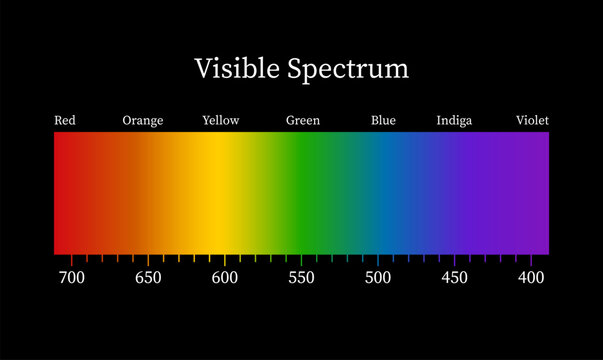
First defined range: 380–700 nm; frequencies ≈430–770 THz; colors violet to red; human trichromatic perception via cone photoreceptors; standardized photopic and scotopic sensitivity functions used in photometry and colorimetry NASA Science
Britannica
NIST
CIE
CIE.
Definition and Range
The visible spectrum is the portion of the Electromagnetic Spectrum detectable by the human eye. It typically spans wavelengths of about 380 to 700 nanometers (nm), with violet at the short‑wavelength end and red at the long‑wavelength end, corresponding to frequencies on the order of 7.5×10^14 to 4.3×10^14 hertz (≈430–770 terahertz) NASA Science
Britannica. The National Institute of Standards and Technology (NIST) designates 400–700 nm as “visible” within its optical spectral ranges, noting that such boundaries are conventional rather than exact
NIST.
Colors and Wavelengths
When white light passes through a Prism, dispersion separates it into a sequence commonly listed as violet, indigo, blue, green, yellow, orange, and red (ROYGBIV) Smithsonian Libraries. Typical representative wavelengths fall near 400 nm (violet), 450 nm (blue), 500 nm (cyan), 550 nm (green), 580 nm (yellow), 600 nm (orange), and 650–700 nm (red)
Britannica. Frequency values for these colors are on the order of 4.3×10^14–7.5×10^14 Hz, illustrating the inverse wavelength–frequency relationship
Britannica. Educational references similarly summarize red light at longer wavelengths and lower frequencies (~700 nm, ~430 THz) and blue/violet at shorter wavelengths and higher frequencies (~400 nm, ~750 THz)
UCAR Center for Science Education.
Historical Development
Systematic study of the visible spectrum began in the 17th century. Isaac Newton’s prism experiments demonstrated that white light is composed of component colors that refract by different amounts, establishing the spectral nature of color and popularizing the ROYGBIV ordering Smithsonian Libraries. Newton’s results were published in his 1704 work Opticks, a foundational text in optics [Opticks](book://Newton|Opticks|London: Smith & Walford|1704).
Biological Basis of Perception
Human color vision under daylight (photopic) conditions depends on three classes of cone photoreceptors—short‑ (S), medium‑ (M), and long‑ (L) wavelength sensitive—that have distinct spectral sensitivities and together enable trichromatic color matching Stockman & Sharpe. Psychophysical and physiological estimates place their peak sensitivities approximately in the S ~420–440 nm, M ~530–540 nm, and L ~560–565 nm ranges (values vary with methodology and individual differences)
Stockman & Sharpe. Under low‑light (scotopic) conditions, vision is dominated by rods, whose collective spectral sensitivity is described by the CIE V′(λ) function with a peak near 507 nm
CIE
Stockman & Sharpe.
Photometry and Colorimetry Standards
Photometry quantifies light weighted by human visual sensitivity. The CIE photopic luminous efficiency function V(λ) specifies the standardized relative sensitivity of the average eye to wavelengths across the visible, and underpins the candela and lumen definitions and colorimetric observers used in CIE 1931 Color Space CIE. The scotopic function V′(λ) describes rod‑mediated sensitivity in dim conditions
CIE. NIST and other metrology institutes classify the visible band within broader optical spectral nomenclature (e.g., near‑infrared and ultraviolet abutting visible) for measurement and standards work
NIST.
Context in the Electromagnetic Spectrum
Visible light is a narrow band between Ultraviolet at shorter wavelengths and Infrared at longer wavelengths within the electromagnetic continuum NASA Science. Its study is central to Optics, spectroscopy, astronomy, and imaging technologies, and it provides the physical basis for human color perception and color technology
NASA Science
Britannica.