Vitamin B12 (cobalamin) is a water‑soluble vitamin required for neurologic function, erythropoiesis, and DNA synthesis in humans. It occurs in several cobalamin forms; methylcobalamin and 5‑deoxyadenosylcobalamin are the biologically active coenzymes used in cellular metabolism. According to the National Institutes of Health Office of Dietary Supplements, the Recommended Dietary Allowance (RDA) for adults in the United States is 2.4 micrograms (µg) per day, with higher targets during pregnancy (2.6 µg) and lactation (2.8 µg). National Institutes of Health.
Chemistry and biological forms
Cobalamins are cobalt‑containing compounds with a corrin ring; common supplemental or pharmacologic forms include cyanocobalamin and hydroxocobalamin, which are converted in vivo to methylcobalamin and adenosylcobalamin. The vitamin’s coenzymic roles are in methionine synthase (remethylation of homocysteine to methionine) and L‑methylmalonyl‑CoA mutase (conversion of methylmalonyl‑CoA to succinyl‑CoA). NIH Office of Dietary Supplements;
britannica.com.
Sources and biosynthesis in nature
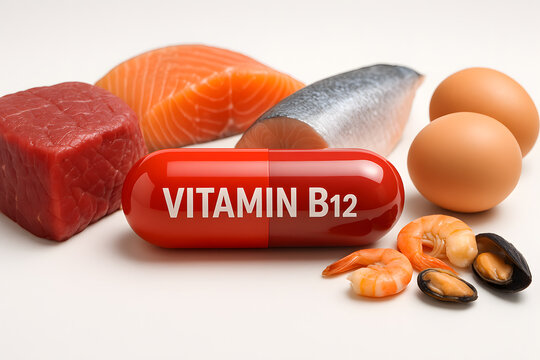
Vitamin B12 is synthesized by microorganisms and accumulates in animal tissues; natural food sources include meat, fish, dairy, and eggs, whereas unfortified plant foods do not naturally supply cobalamin. Fortified foods (e.g., breakfast cereals and nutritional yeast) and dietary supplements provide reliable sources for individuals limiting animal products. NIH Office of Dietary Supplements;
britannica.com.
Absorption, transport, and storage
In food, vitamin B12 is protein‑bound and is released by gastric acid and proteases, then binds salivary haptocorrin; in the duodenum it transfers to intrinsic factor secreted by parietal cells. The intrinsic factor–B12 complex is absorbed in the distal ileum by receptor‑mediated endocytosis; fortified and supplemental B12, already unbound, bypasses the initial release step. Intrinsic factor mediates absorption, and deficiency of intrinsic factor, as in Pernicious anemia, impairs uptake. NIH Office of Dietary Supplements.
Physiological functions
Vitamin B12 functions as a cofactor for methionine synthase, supporting one‑carbon metabolism and regeneration of tetrahydrofolate, thereby linking B12 status to Folate metabolism and DNA synthesis. It also serves as a cofactor for L‑methylmalonyl‑CoA mutase in propionate and odd‑chain fatty acid metabolism. Disturbances in these pathways can elevate biomarkers such as Homocysteine and methylmalonic acid (MMA). NIH Office of Dietary Supplements.
Dietary recommendations
The U.S. Food and Nutrition Board (FNB) at the National Academies sets RDAs of 2.4 µg/day for adults, 2.6 µg/day in pregnancy, and 2.8 µg/day in lactation. No Tolerable Upper Intake Level (UL) is established due to the vitamin’s low toxicity. The European Food Safety Authority sets an Adequate Intake (AI) for adults at 4 µg/day based on biomarker data (holo‑transcobalamin, serum B12, MMA, and total homocysteine). National Academies/NIH ODS;
European Food Safety Authority;
European Food Safety Authority.
Status assessment
Clinical assessment commonly begins with serum or plasma B12, with many laboratories considering concentrations below about 200–250 pg/mL as low; confirmatory markers include elevated MMA and, less specifically, elevated total homocysteine. Measurement of these metabolites is recommended when serum B12 levels are borderline to improve diagnostic accuracy. NIH Office of Dietary Supplements.
Deficiency, risk groups, and clinical features
Deficiency arises from malabsorption (including loss of intrinsic factor), gastric or ileal disease or surgery, prolonged use of certain medications (notably metformin and gastric acid inhibitors), and insufficient intake, especially in strict vegans and in breastfed infants of vegan mothers without supplementation. Symptoms can include megaloblastic anemia, glossitis, fatigue, and neurologic changes (e.g., paresthesias and impaired gait). Older adults, individuals with Pernicious anemia or inflammatory bowel disease, and post‑bariatric surgery patients are at increased risk. NIH Office of Dietary Supplements.
Treatment and supplementation
Vitamin B12 can be repleted by parenteral routes (e.g., intramuscular hydroxocobalamin or cyanocobalamin) or by high‑dose oral regimens; evidence indicates that sufficiently high oral doses can normalize serum B12 similarly to intramuscular therapy in many contexts of deficiency. Ongoing management addresses underlying causes (e.g., autoimmune gastritis) and long‑term maintenance dosing as indicated. NIH Office of Dietary Supplements;
StatPearls.
Safety and interactions
No UL has been established; even large supplemental doses are generally considered safe. Certain medications can lower B12 status by reducing absorption, particularly proton pump inhibitors and H2‑receptor antagonists (via reduced gastric acidity) and metformin (via effects on absorption and transport). Clinicians often monitor status when these medications are used long term. NIH Office of Dietary Supplements.
Industrial production
Because total chemical synthesis of cobalamin is complex and economically impractical, commercial supply relies on microbial fermentation, chiefly with Pseudomonas denitrificans and Propionibacterium (now Cutibacterium) freudenreichii; the product is commonly converted to cyanocobalamin for stability. PMC;
MDPI.
Historical notes
Liver therapy for pernicious anemia, introduced clinically by George R. Minot and William P. Murphy building on George H. Whipple’s work, was recognized with the 1934 Nobel Prize in Physiology or Medicine. The vitamin’s crystalline form was reported in 1948, and the three‑dimensional structure of vitamin B12 was solved by Dorothy Hodgkin using X‑ray crystallography, for which she received the 1964 Nobel Prize in Chemistry. Nobel Prize;
Science;
Nobel Prize;
britannica.com.