Nebulae

H II region
An H II region is a cloud of interstellar gas in which hydrogen is ionized by the ultraviolet radiation of nearby massive stars, producing strong emission lines and free–free continuum. Typically 10–50 light‑years across with gas temperatures around 8,000 K, these regions trace recent massive star formation in galaxies and are embedded in or adjacent to molecular clouds and photodissociation regions.

Nebula
A nebula is a tenuous cloud of gas and dust in interstellar space within a galaxy, often associated with the birth or death of stars. Historically the term also encompassed distant 'spiral nebulae' now recognized as external galaxies, but in modern astronomy it refers to interstellar clouds such as emission, reflection, dark nebulae, planetary nebulae, and supernova remnants.
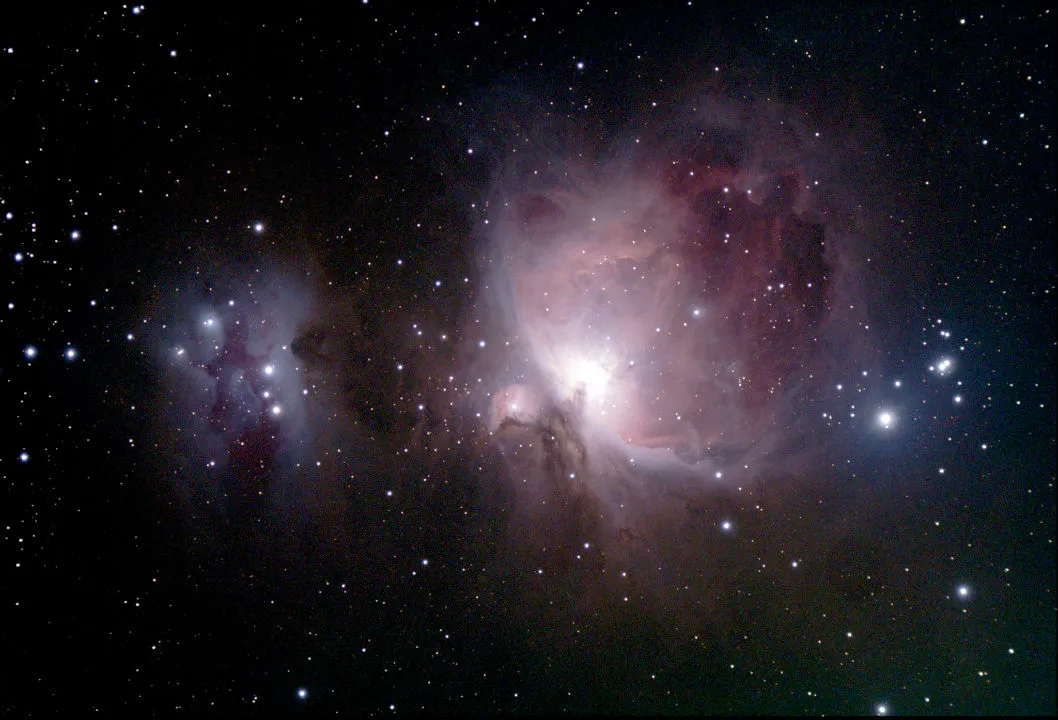
Orion Nebula
The Orion Nebula (Messier 42, NGC 1976) is a bright H II region within the Orion Molecular Cloud Complex, visible to the unaided eye in the sword of the Orion constellation. Located roughly 1,300–1,500 light-years from Earth, it is a nearby laboratory for studying massive star formation, protoplanetary disks, and the interaction between hot, young stars and their natal gas and dust.
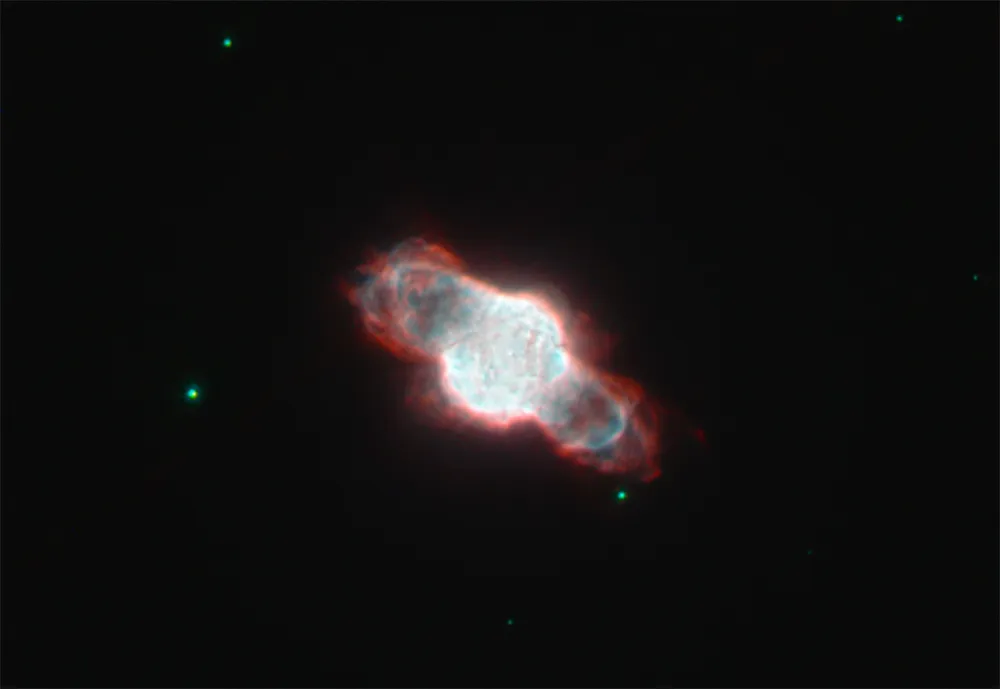
Planetary nebula
A planetary nebula is an expanding, glowing shell of ionized gas ejected by a low- or intermediate-mass star near the end of its life. Ultraviolet radiation from the exposed hot core ionizes the outflow, producing characteristic emission lines and intricate morphologies. Planetary nebulae enrich the interstellar medium and serve as tools for measuring distances and galaxy dynamics.