Plate Tectonics

East Pacific Rise
The East Pacific Rise is a fast-spreading mid-ocean ridge in the eastern Pacific Ocean that forms a divergent plate boundary and major center of seafloor spreading. Extending from near the mouth of the Gulf of California to the high southern latitudes where it transitions into the Pacific–Antarctic Ridge, it generates new oceanic crust and hosts prolific hydrothermal vent systems. The rise is characterized by high spreading rates, an axial high lacking a deep rift valley, and abundant volcanic and tectonic segmentation.

Magma
Magma is molten or partially molten rock beneath Earth’s surface that contains liquid melt, solid crystals, and dissolved gases. Its composition, temperature, and volatile content control viscosity, storage and transport in the crust, and the style of volcanic eruptions once it reaches the surface as lava.
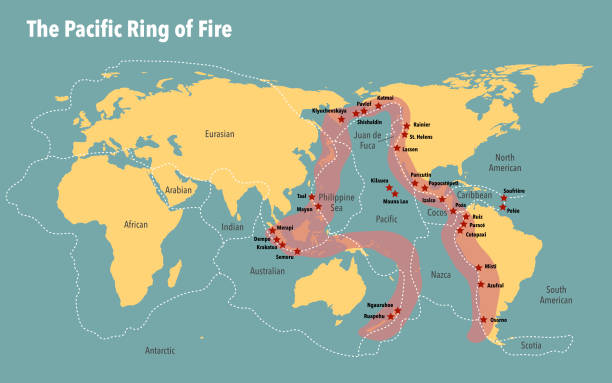
Pacific Ring of Fire
The Pacific Ring of Fire is a 40,000-kilometer horseshoe-shaped belt of intense seismicity and volcanism that rims the Pacific Ocean. It hosts about 75% of Earth’s active volcanoes and roughly 90% of global earthquakes due to interactions among major and micro tectonic plates, especially at subduction zones. The belt includes deep ocean trenches such as the Mariana Trench and has produced many of the world’s largest recorded earthquakes.

Pangaea
Pangaea was a supercontinent that existed during the late Paleozoic and early Mesozoic eras, assembling approximately 335 million years ago and beginning to break apart around 200 million years ago. It encompassed nearly all of Earth's landmasses and was surrounded by the vast Panthalassa Ocean.