Solar Physics
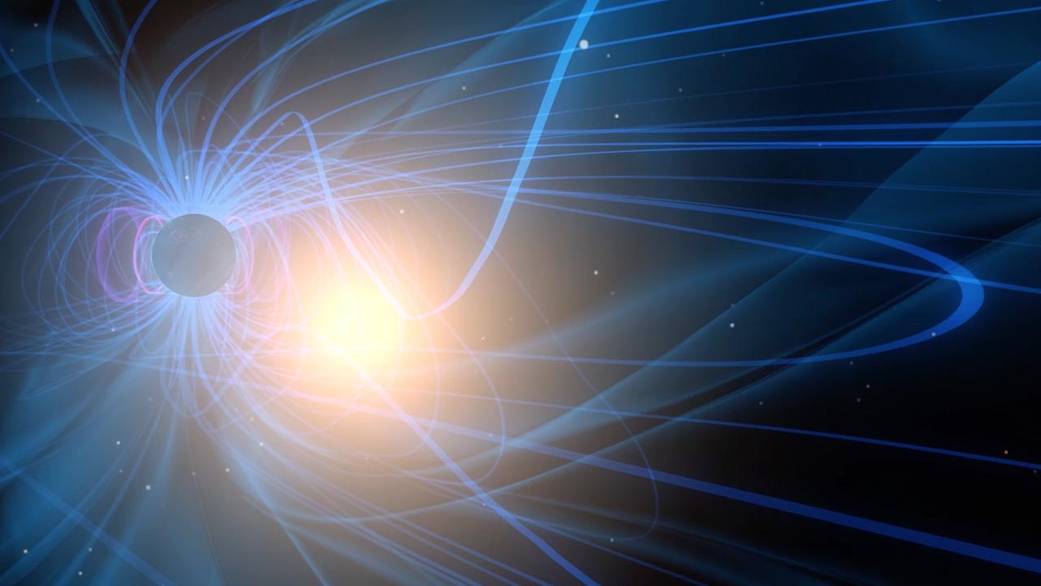
Magnetic reconnection
Magnetic reconnection is a fundamental process in plasma physics in which magnetic field lines change connectivity, rapidly converting stored magnetic energy into plasma kinetic energy, heating, and particle acceleration. It operates in the Sun’s corona, Earth’s magnetosphere, the solar wind, astrophysical systems, and laboratory devices, and is central to phenomena such as solar flares, geomagnetic substorms, and disruptions in fusion experiments.
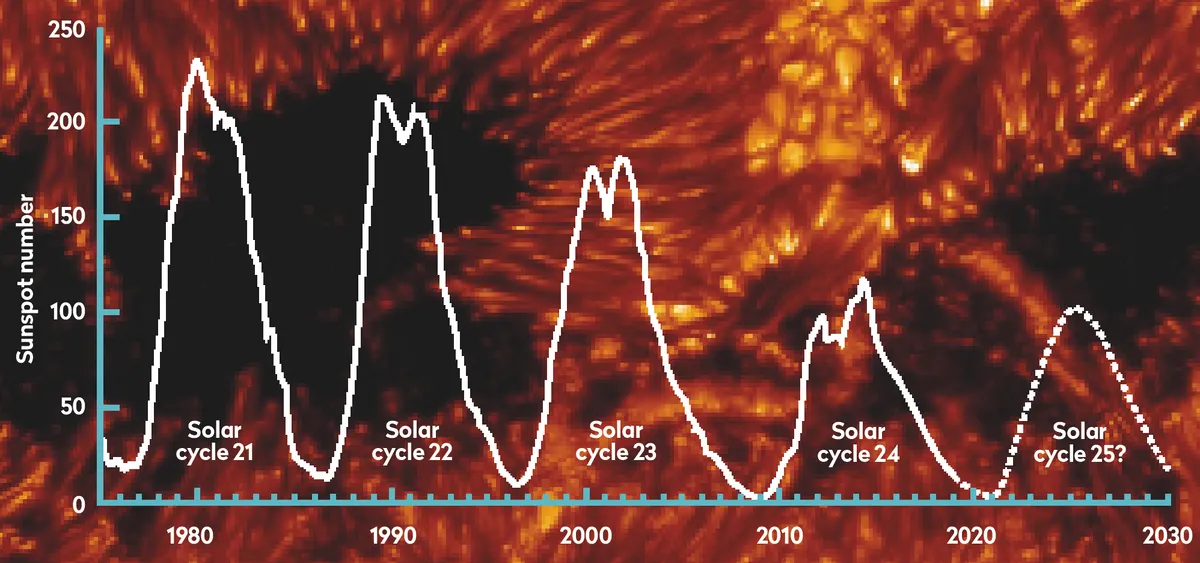
Solar cycle
The solar cycle is the approximately 11-year periodic modulation of the Sun’s magnetic activity, observed most directly through the rise and fall of sunspot numbers and associated phenomena such as solar flares and coronal mass ejections. Its magnetic polarity reverses every ~22 years (the Hale cycle), shaping variability throughout the heliosphere and influencing space weather conditions at Earth.
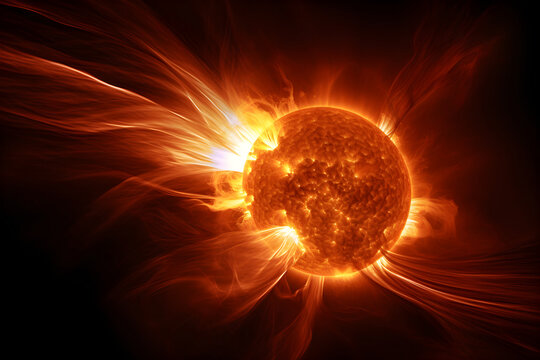
Solar flare
A solar flare is a sudden, intense burst of electromagnetic radiation from the Sun caused by the rapid release of magnetic energy in active regions near sunspots. Flares emit across the spectrum from radio waves to gamma rays, occur on timescales of minutes to hours, and can disrupt radio communications and affect spacecraft when directed toward Earth.

Solar wind
The solar wind is a continuous outflow of ionized gas from the Sun’s corona that permeates the Solar System, carrying the Sun’s magnetic field and shaping the heliosphere. It varies between slower and faster streams, interacts with planetary magnetospheres and atmospheres, and drives space weather phenomena such as geomagnetic storms and auroras.

Sun
The Sun is a G2V (G‑type main‑sequence) star at the center of the Solar System whose gravity, radiation, and magnetic activity dominate the heliosphere. It contains about 99.8% of the Solar System’s mass, converts hydrogen to helium by nuclear fusion in its core, and powers Earth’s climate and space weather. Its basic reference properties are standardized by the International Astronomical Union, including a nominal radius of 695,700 km, luminosity of 3.828×10^26 W, and effective temperature of 5772 K.