Stellar Evolution

Nebula
A nebula is a tenuous cloud of gas and dust in interstellar space within a galaxy, often associated with the birth or death of stars. Historically the term also encompassed distant 'spiral nebulae' now recognized as external galaxies, but in modern astronomy it refers to interstellar clouds such as emission, reflection, dark nebulae, planetary nebulae, and supernova remnants.
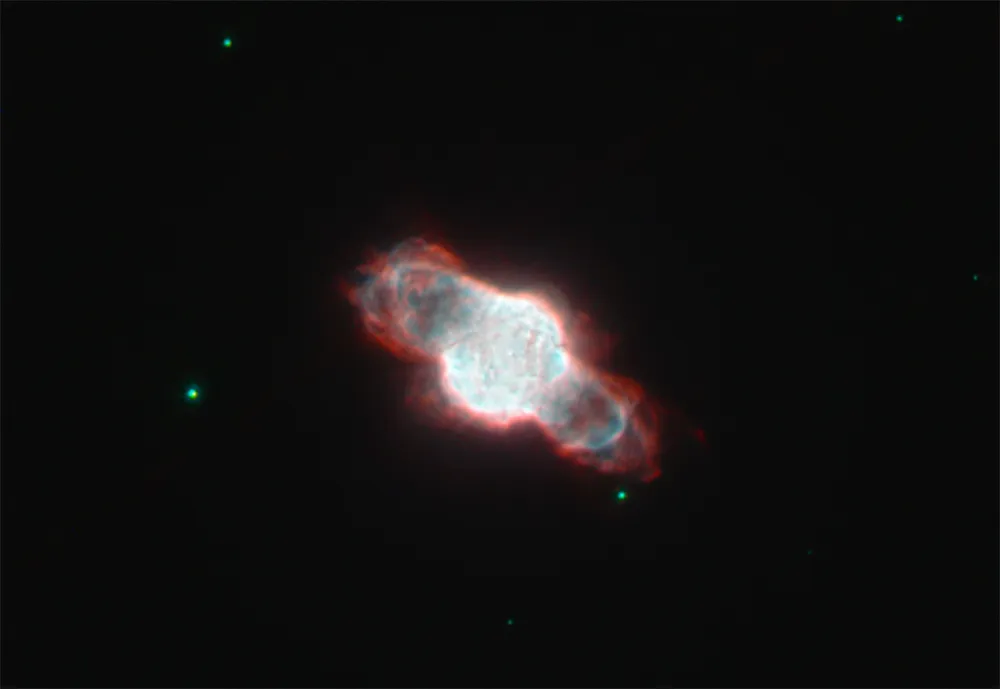
Planetary nebula
A planetary nebula is an expanding, glowing shell of ionized gas ejected by a low- or intermediate-mass star near the end of its life. Ultraviolet radiation from the exposed hot core ionizes the outflow, producing characteristic emission lines and intricate morphologies. Planetary nebulae enrich the interstellar medium and serve as tools for measuring distances and galaxy dynamics.
Supernova
A supernova is a stellar explosion that briefly rivals the brightness of an entire galaxy, dispersing heavy elements and often leaving behind a compact remnant. Astronomers distinguish thermonuclear Type Ia supernovae, which explode from white dwarfs in binary systems, from massive-star core‑collapse events (Types II, Ib, and Ic). Supernovae are central to nucleosynthesis, cosmic‑ray acceleration, and cosmology.