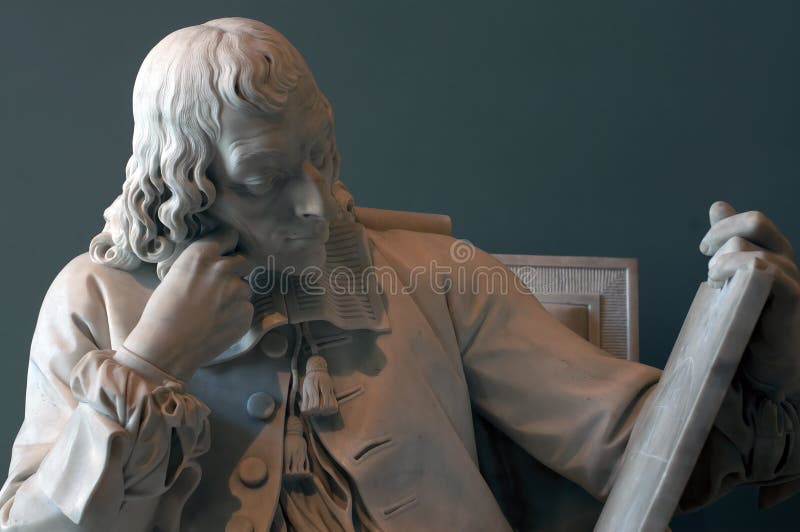
Blaise Pascal (19 June 1623 – 19 August 1662) was a French mathematician, physicist, inventor, and religious writer noted for foundational work in geometry, hydrostatics and probability, as well as influential prose in theology and apologetics. Britannica.
Early life and education
Pascal was born in Clermont-Ferrand and moved with his family to Paris in 1631, where his father Étienne, a capable mathematician, oversaw his education and introduced him to the Mersenne circle; by 1640 Pascal had produced his Essai pour les coniques, announcing results in projective geometry. Britannica;
Encyclopædia Universalis;
Stanford Encyclopedia of Philosophy.
In this youthful work Pascal formulated what became known as Pascal’s theorem (the “hexagramme mystique”), a key proposition of projective geometry, extending methods inspired by Girard Desargues. Encyclopædia Universalis;
1911 Encyclopædia Britannica (Wikisource).
Mathematics and invention
Between 1642 and 1645 Pascal designed and built calculating machines to assist his father’s tax work; these devices, later called the Pascaline, performed addition and subtraction with automatic carry via a “sautoir” mechanism. Britannica;
Musée des Arts et Métiers;
Musée des Arts et Métiers (object record).
Only about a dozen Pascalines are known to survive, including multiple examples held by the Musée des Arts et Métiers in Paris. Musée des Arts et Métiers (object record);
Musée des Arts et Métiers (overview).
Pascal also studied the cycloid and applied indivisibles methods, contributing to problems of areas, centers of gravity, and solids of revolution that prefigured later calculus developments. Britannica;
1911 Encyclopædia Britannica (Wikisource).
Experiments on vacuum, air pressure, and hydrostatics
After hearing of Evangelista Torricelli’s barometric experiments, Pascal repeated and extended them, publishing Expériences nouvelles touchant le vide (1647), a concise report of vacuum experiments using various liquids and apparatus. BNF exposition;
Wikisource text.
Too ill to climb himself, Pascal arranged for his brother-in-law Florin Périer to carry a mercury barometer up the Puy-de-Dôme in 1648, observing the fall in column height with altitude and thereby demonstrating that air has weight. Stanford Encyclopedia of Philosophy;
Christie’s catalogue note, Traitez (1663).
He synthesized these results in the posthumous Traitez de l’équilibre des liqueurs et de la pesanteur de la masse de l’air (Paris, 1663), edited by Périer, which contains the first published statement of what became known as Pascal’s law: pressure applied to a confined fluid is transmitted undiminished in all directions. Christie’s catalogue note, Traitez (1663);
Britannica.
His experimental and theoretical work in hydrodynamics and hydrostatics underpinned practical devices such as the hydraulic press and syringe. Britannica.
Probability and the arithmetic triangle
In 1654 Pascal exchanged letters with Pierre de Fermat about gambles posed by the Chevalier de Méré, producing solutions to the “problem of points” and laying foundations for modern probability theory. Britannica;
Stanford Encyclopedia of Philosophy;
Problem of points (overview).
Pascal’s Traité du triangle arithmétique—printed in 1654 and distributed with preliminaries in 1665—systematized properties and applications of the array now called Pascal’s triangle, with results central to combinatorics and binomial coefficients, and included an explicit formulation of mathematical induction. Gallica (BNF) digitization, 1665);
Christie’s catalogue note, first edition (1665);
Britannica.
Religious commitment, Port-Royal, and controversies
From 1646 Pascal encountered the austere Augustinian movement of Jansenism, centered at Port‑Royal, which shaped his later spiritual and literary work. Britannica;
Stanford Encyclopedia of Philosophy.
On the night of 23 November 1654 he experienced the “night of fire,” recording an intense personal testimony known as the “Mémorial,” which he sewed into his coat and kept until his death. Britannica;
CCEL, Memorial (text and translation).
Beginning in 1656, under the pseudonym Louis de Montalte, Pascal published the Les Provinciales, eighteen polemical letters defending Antoine Arnauld and attacking Jesuit casuistry, which quickly circulated and set a model of classical French style. BNF Essentiels.
Pensées and Pascal’s wager
Pascal assembled notes toward an Apologie de la religion chrétienne; after his death these fragments were published in 1670 as the Pensées, a landmark of religious philosophy exploring human greatness and wretchedness, grace, and the limits of reason. Britannica;
Project Gutenberg (Pensées, English).
Among the Pensées is the probabilistic argument known as Pascal’s wager, urging that, given the stakes and uncertainties, living as if God exists is the rational choice. Stanford Encyclopedia of Philosophy;
Project Gutenberg (Pensées, English).
Public transport experiment
In 1661–1662 Pascal and associates established the “carrosses à cinq sols,” a network of horse‑drawn coaches on fixed routes with fixed fares—an early urban public transport system in Paris. BNF Essentiels (Carrosses à cinq sols).
Illness, death, and legacy
Pascal suffered chronic illness and died in Paris on 19 August 1662 at age 39. Britannica.
In recognition of his contributions to fluid mechanics, the SI unit of pressure, the pascal (Pa), bears his name, defined as one newton per square metre. Britannica (pascal, unit).
Selected works and primary editions
• Expériences nouvelles touchant le vide (1647), a concise report of vacuum experiments. BNF exposition;
Wikisource text.
• Traitez de l’équilibre des liqueurs et de la pesanteur de la masse de l’air (1663), first edition edited posthumously by Florin Périer. Christie’s catalogue note.
• Traité du triangle arithmétique (1654; 1665 issue with preliminaries), first comprehensive study of the arithmetic triangle. Gallica (BNF);
Christie’s catalogue note.
• Les Provinciales (1656–1657), polemical letters published under a pseudonym. BNF Essentiels.
• Pensées (1670), posthumous fragments toward an apology of Christianity. Project Gutenberg (English translation);
BNF catalogue entry on 1670 edition.