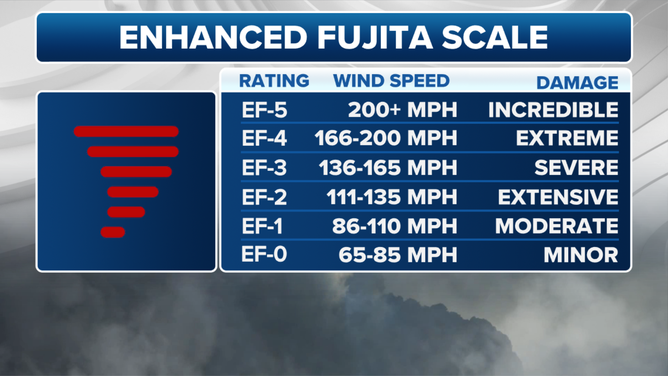
Adopted: 2007 (U.S.); Type: tornado damage-based intensity scale; Range: EF0–EF5; Basis: 3-second gust estimates; Method: 28 damage indicators and 8 degrees of damage NWS Norman;
SPC;
TTU WISE.
Overview
The Enhanced Fujita (EF) Scale rates tornado intensity based on the severity of damage observed to specific types of structures and vegetation. It refines the original Fujita Scale by incorporating engineering assessments to better align estimated wind speeds with actual damage. The scale is expressed in six categories (EF0–EF5), representing increasing levels of destruction and corresponding estimated 3‑second gusts at the point of damage NWS Norman;
SPC.
Development and Adoption
The EF Scale was developed through a multidisciplinary effort led by the Texas Tech University Wind Science and Engineering (WISE) Center, with input from meteorologists and structural engineers and technical oversight from NIST. The project addressed limitations of the original scale, including a paucity of damage indicators, lack of accounting for construction quality, and uncertain damage‑wind correlations. The final recommendation (Revision 2) was issued in October 2006 and adopted operationally by the U.S. National Weather Service on February 1, 2007 TTU WISE;
SPC;
NWS Norman. Peer‑reviewed discussion of the transition and rationale is provided in Doswell III (2009)
Atmospheric Research.
Methodology: Damage Indicators and Degrees of Damage
The EF Scale relies on 28 standardized Damage Indicators (DIs)—covering buildings, infrastructure, and trees—each with eight Degrees of Damage (DoD) that range from initial visible damage to complete destruction. Surveyors identify applicable DIs at multiple locations, match observed damage to the best‑fitting DoD, and use associated lower‑bound, expected, and upper‑bound wind estimates to infer intensity. Ratings are assigned based on the highest substantiated wind estimate within the path. Wind values represent 3‑second gusts and are estimates derived from damage, not direct measurements NWS Norman;
SPC;
TTU WISE.
Representative DIs include one‑ or two‑family residences (FR12), mobile homes (MHSW/MHDW), retail buildings, schools, high‑rise buildings, transmission towers, free‑standing poles, and hardwood/softwood trees SPC. The EF protocol emphasizes considering multiple DIs and construction quality when deriving a final event rating
TTU WISE;
NWS Norman.
Wind Speed Ranges and Relation to the Original Scale
Operational U.S. EF categories and estimated 3‑second gusts are: EF0 (65–85 mph), EF1 (86–110 mph), EF2 (111–135 mph), EF3 (136–165 mph), EF4 (166–200 mph), and EF5 (>200 mph). These bounds were derived from regression of EF damage‑wind relationships against converted F‑scale speeds and subsequently rounded for operational use, providing backward compatibility of ratings (e.g., F3 ≈ EF3) though with revised wind ranges SPC;
TTU WISE;
NWS Norman.
Use in Canada and Adaptations
Environment and Climate Change Canada adopted a national EF Scale on April 1, 2013, after evaluating U.S. implementation. The Canadian version includes 31 DIs and expresses ranges in km/h, from 90 km/h (low end of EF0) to ≤315 km/h (high end of EF5). Minor adaptations reflect Canadian construction practices; ratings remain backward compatible with the original F‑scale ECCC.
Operational Practice
In the United States, only the National Weather Service assigns official EF ratings. Surveys combine aerial and ground assessments to locate multiple DIs, evaluate DoDs, and document construction quality before determining the highest credible intensity along the damage path. The EF Scale uses 3‑second gust estimates at the point of damage and explicitly differs from standard, instrumented 10‑m wind observations in open exposure NWS Norman;
SPC.
Notable EF5 Tornadoes (U.S.)
Since 2007, several violent tornadoes have been rated EF5 by the NWS, including the May 4, 2007 Greensburg tornado, the May 22, 2011 Joplin Tornado, and the May 20, 2013 2013 Moore Tornado. These ratings reflect catastrophic damage consistent with >200 mph estimated gusts, assessed via EF DIs and DoDs SPC;
NWS Norman. (Event documentation: NWS and SPC archives; see also peer‑reviewed reviews such as Doswell III 2009
Atmospheric Research.)
Relation to Other Scales and Context
The EF Scale supersedes the original Fujita Scale in the United States and complements other regional scales such as the TORRO Tornado Intensity Scale. It forms part of broader tornado science and risk assessment frameworks maintained by the Storm Prediction Center and National Weather Service, with foundational research contributions from Texas Tech University engineering programs SPC;
TTU WISE.