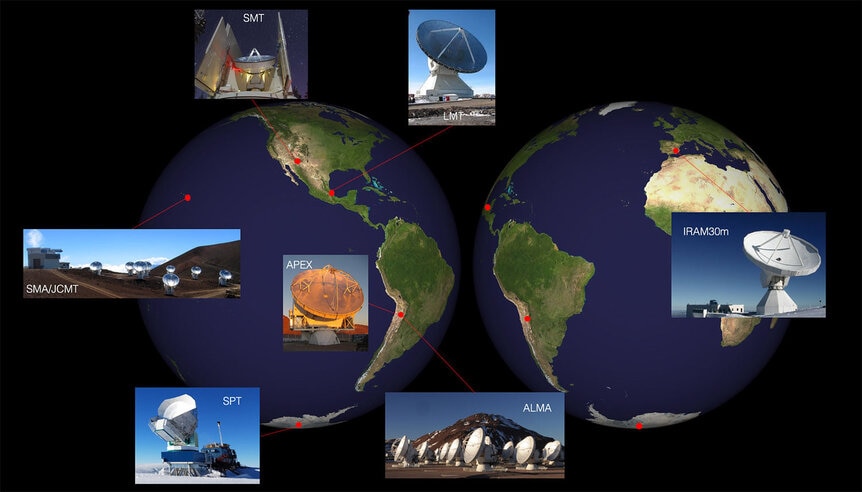
The Event Horizon Telescope (EHT) is a planet‑scale array of millimeter and submillimeter radio observatories linked by Very Long Baseline Interferometry to resolve event‑horizon‑scale structure around supermassive Black holes at 230 GHz (1.3 mm) and, in development, 345 GHz (0.87 mm). According to the collaboration, the array’s 2017 campaign formed an Earth‑sized virtual telescope that achieved angular resolution of tens of microarcseconds, enabling the first direct image of a black hole’s shadow. Event Horizon Telescope;
MIT Haystack Observatory.
Origins and collaboration
Work toward horizon‑scale imaging grew from early 1.3‑mm VLBI detections of compact structure in Sagittarius A* in 2007–2008, which constrained the intrinsic size to ∼37 microarcseconds and demonstrated the feasibility of event‑horizon‑scale measurements. Nature;
arXiv. The EHT Collaboration coalesced in the 2000s–2010s across North America, Europe, East Asia, and Chile; by 2019–2022 it encompassed several hundred researchers and multiple stakeholder institutes coordinating observing, correlation, calibration, and imaging.
Event Horizon Telescope;
Center for Astrophysics | Harvard & Smithsonian.
Array and instrumentation
During the 2017 observations the EHT linked eight facilities: Atacama Large Millimeter/submillimeter Array (ALMA), Atacama Pathfinder EXperiment (APEX), IRAM 30‑m (Pico Veleta), James Clerk Maxwell Telescope (JCMT), Submillimeter Array (SMA), Large Millimeter Telescope (LMT), Submillimeter Telescope (SMT), and the South Pole Telescope (SPT). Event Horizon Telescope;
ALMA Observatory. The ALMA Phasing Project, led by MIT Haystack Observatory, coherently summed ALMA’s antennas into a single ultra‑sensitive VLBI element; this capability was fundamental to the 2019 imaging.
MIT Haystack Observatory. Subsequent campaigns incorporated the Greenland Telescope, NOEMA, and the Kitt Peak 12‑m, improving baseline coverage from 2018 onward.
Event Horizon Telescope;
BlackHoleCam.
The EHT records petabytes of baseband data at each site using hydrogen‑maser timing and wide‑band backends, then ships the media to correlators at MIT Haystack Observatory (Westford, MA) and the Max Planck Institute for Radio Astronomy (MPIfR, Bonn) for correlation, calibration, and initial quality control. MIT Haystack Observatory;
MPIfR. The standard observing frequency is 230 GHz; successful experimental detections at 345 GHz (870 μm) in 2018 demonstrated technical readiness for higher‑frequency EHT VLBI.
OSTI.gov.
Imaging methods and data processing
Calibration and imaging for the 2017 campaign employed multiple independent pipelines and algorithms to assess robustness, including CLEAN and regularized maximum‑likelihood approaches (e.g., SMILI), with cross‑checks across teams to mitigate bias. The Astrophysical Journal Letters;
arXiv. The EHT used closure quantities and extensive simulations to validate ring‑like morphology and to constrain model parameters, with correlated‑flux nulls and closure‑phase behavior indicating horizon‑scale structure and variability.
arXiv;
The Astrophysical Journal Letters.
Landmark results
On 10 April 2019, the collaboration released the first direct image of a black hole: the supermassive object M87* at the heart of giant elliptical galaxy Messier 87, revealing a bright ring with a central “shadow” consistent with lensing of synchrotron emission around the photon orbit. Event Horizon Telescope;
The Astrophysical Journal Letters. Multi‑paper analyses reported a ring diameter of ≈40–44 μas and derived a black hole mass of about 6.5 billion solar masses (methods‑dependent), consistent with general relativity predictions.
The Astrophysical Journal Letters;
OSTI.gov.
In March 2021, the EHT presented the first polarized‑light image of M87*, mapping the near‑horizon magnetic‑field geometry and indicating an organized, magnetized flow that helps launch and collimate the relativistic jet. ESO;
MIT News. Coordinated multi‑wavelength observations in 2017 and 2018 connected horizon‑scale emission with jet activity across the spectrum.
MIT Haystack Observatory;
MPIfR.
On 12 May 2022, the collaboration unveiled the first image of Sgr A*, the ∼4 million‑solar‑mass black hole at the Milky Way’s center, resolving a ring‑like structure despite minute‑scale variability that complicates imaging. ESO;
Event Horizon Telescope. Follow‑up polarized‑light results reported in March 2024 revealed a strong, organized magnetic‑field pattern around Sgr A*, broadly similar to M87*, suggesting magnetic fields are a common near‑horizon feature of accreting supermassive black holes.
Reuters;
The Astrophysical Journal Letters.
Extended campaigns and evolving array
The EHT has expanded its station list and observing cadence beyond 2017, adding NOEMA and the Kitt Peak 12‑m in 2021 and refining coverage in 2022, with improved dynamic imaging of M87* and Sgr A*. Event Horizon Telescope;
BlackHoleCam. A 2025 analysis of 2017–2018–2021 data reported a persistent M87* ring diameter (~44 μas) with evolving azimuthal brightness and changing polarization patterns, consistent with a dynamic, magnetized accretion flow.
arXiv. Experimental 0.87‑mm VLBI detections in 2018 confirmed readiness for higher‑frequency campaigns that can sharpen resolution and reduce scattering.
OSTI.gov.
Funding and governance
The EHT leverages existing facilities and is supported by a patchwork of international agencies and partners; key contributions include the U.S. National Science Foundation, the European Southern Observatory and European partners, and East Asian institutions associated with ALMA and regional observatories. Event Horizon Telescope;
ALMA Observatory. Correlation is performed at MIT Haystack Observatory and at the Max Planck Institute for Radio Astronomy, reflecting the collaboration’s distributed data‑processing model.
MIT Haystack Observatory;
MPIfR.
Scientific context
By imaging the black hole shadow and ring in M87* and Sgr A*, the EHT provides tests of general relativity in the strong‑field regime and constraints on accretion physics, jet launching, and magnetic‑field structure on event‑horizon scales. The Astrophysical Journal Letters;
ESO. The program continues to integrate higher frequencies, more baselines, and multi‑wavelength coordination to produce time‑variable reconstructions (“movies”) of horizon‑scale plasma dynamics.
MIT News;
arXiv.