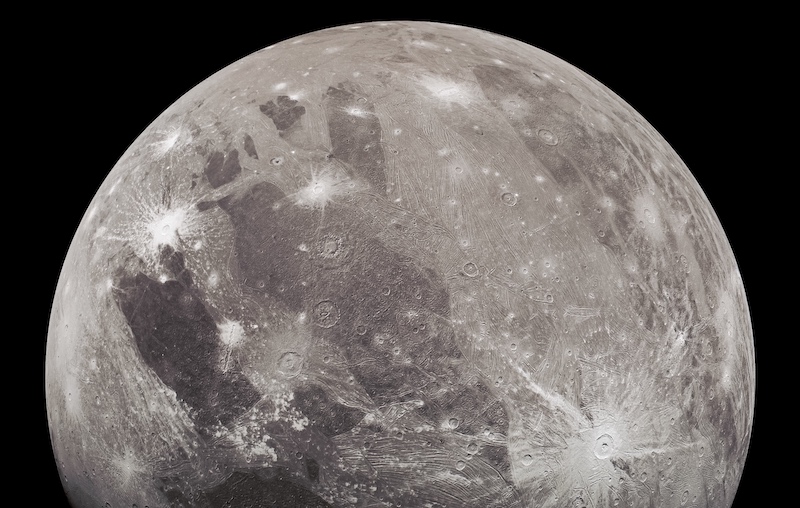
Ganymede is the largest natural satellite in the Solar System and orbits Jupiter, with a diameter of about 5,260 km and a mass of 1.4819 × 10^23 kg; its bulk density (~1.94 g/cm³) implies a mixture of rocky material and water ice. According to NASA and the National Space Science Data Center, it is tidally locked and completes one orbit in about 7.155 Earth days at a mean distance of roughly 1,070,400 km from Jupiter. It is the only known moon with its own intrinsic magnetic field. NASA Science;
NSSDC/Jovian Satellite Fact Sheet.
Discovery and naming
Ganymede was discovered by Galileo Galilei on January 7, 1610; the name, proposed by Simon Marius, follows classical mythology in which Ganymede was the cupbearer of the gods. Encyclopaedia Britannica notes its designation as Jupiter III among the Galilean moons. Britannica.
Orbit and resonance
Ganymede is part of a 1:2:4 Laplace resonance with Europa and Io: for each orbit of Ganymede, Europa completes two and Io completes four, maintaining slight orbital eccentricities and driving tidal effects in the Jovian system. NASA’s Solar System Exploration profile summarizes its orbital period (7.155 days), tidal locking, and resonance configuration. NASA Solar System Exploration.
Internal structure and potential ocean
Gravity and magnetic data from the Galileo mission indicate a differentiated interior with a metallic (iron-rich) core, a silicate mantle, and a thick outer ice shell. JPL’s mission reports conclude that a dense metallic core exists and likely powers the intrinsic field; models and spacecraft tracking constrain the layered structure. JPL/PIA00519;
JPL News.
Evidence points to a global subsurface saltwater ocean. Using auroral "rocking" of Ganymede’s ovals seen by the Hubble Space Telescope, Saur and colleagues inferred an electrically conductive layer consistent with a salty ocean beneath the ice shell; NASA’s summary places the ocean roughly 100 km below the surface and possibly tens of kilometers thick. Journal of Geophysical Research: Space Physics (Saur et al., 2015);
NASA Science/Hubble;
NASA Ganymede Facts.
Surface and geology
Images from Voyager and Galileo reveal two principal terrains: older, darker, heavily cratered regions and younger, brighter regions marked by extensive grooved terrain produced by tectonic deformation. USGS and LPI analyses describe grooves typically spaced 5–10 km apart, consistent with extensional faulting in the icy lithosphere; bright ray craters indicate excavation and redistribution of cleaner ice. USGS (Lucchitta 1980);
USGS (Galileo results, 1998);
LPI/USRA;
JPL/PIA01516.
Atmosphere and exosphere
Ganymede hosts a tenuous atmosphere and surface-bound exosphere shaped by sputtering and sublimation. Hubble detected ozone on the surface in 1995, and subsequent UV observations established molecular oxygen and auroral emissions consistent with a weak atmosphere. In 2021, re-analysis of Hubble datasets found the first evidence of water vapor from sublimation near local noon over warmer equatorial regions. In 2024, JWST reported a patchy carbon dioxide exosphere with localized enhancements near the north polar cap. NASA Science/Hubble—Ozone (1995);
NASA Science—Water vapor (2021);
A&A (2024) JWST CO₂ exosphere;
NASA Science—HST UV images.
Magnetic field and magnetosphere
During close flybys in 1996, Galileo’s magnetometer discovered that Ganymede generates an intrinsic dipole field (equatorial surface strength ~750 nT), forming a mini-magnetosphere embedded within Jupiter’s vast Magnetosphere. The discovery paper in Nature and subsequent magnetometer overviews characterize a magnetopause and complex field topology with open and closed field lines. Juno’s 2021 flyby recorded signatures of magnetic reconnection between Jupiter and Ganymede, refining understanding of field coupling and particle environments. Nature (Kivelson et al., 1996);
GRL (Kivelson et al., 1997) summary;
JGR overview (1998) summary;
JPL/PIA25724;
NASA Science/PIA25724.
Composition and surface materials
Near-infrared spectroscopy by Juno’s JIRAM instrument during the June 2021 flyby detected non–water-ice constituents, including hydrated sodium chloride, ammonium chloride, sodium bicarbonate, and possible aliphatic aldehydes, with distributions influenced by shielding from Ganymede’s magnetic field at certain latitudes. NASA reports interpret some materials as remnants of brines reaching the surface. NASA/JPL—Juno JIRAM results;
NASA Mission page.
Exploration
Spacecraft observations began with Voyager 1 and 2 in 1979, followed by the Galileo orbiter (1995–2003), which provided gravity, magnetic, and high-resolution imaging constraints on internal structure and tectonism. Juno’s distant and close passes since 2019–2021 have supplied new polar views, magnetic, plasma, and spectral data. The European Space Agency’s JUICE mission launched on April 14, 2023, is scheduled to arrive at Jupiter in July 2031 and, after multiple flybys, to enter orbit around Ganymede in 2034—the first dedicated orbit of a moon other than Earth’s. JPL—Ganymede interior and Galileo results;
NASA Science—Juno polar imaging;
ESA JUICE Overview;
ESA mission note.