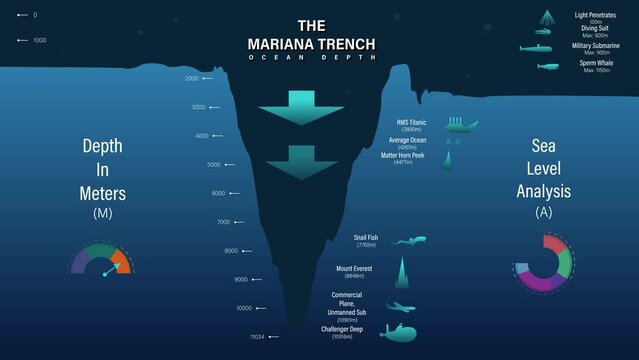
The Mariana Trench is an oceanic trench in the western Pacific Ocean that contains the deepest known point on Earth’s seafloor, the Challenger Deep, and spans more than 1,500 miles (about 2,550 kilometers) in length and roughly 43 miles (69 kilometers) in average width. NOAA NCEI The deepest measured points of the trench occur in the Challenger Deep at approximately 10,924–10,935 meters below mean sea level based on recent high‑resolution multibeam mapping and pressure-referenced submersible dives.
Geoscience Data Journal
Guinness World Records
Geologic setting
The trench formed at a convergent plate boundary where the Pacific Plate is forced beneath the Philippine Sea Plate by Subduction, producing a narrow, steep-walled depression and an adjacent volcanic island arc. Britannica The regional system includes arc volcanoes, back-arc basins, and numerous hydrothermal and mud-volcanic features associated with the broader Pacific Ring of Fire.
NOAA Ocean Exploration Within U.S. waters, the trench segment is protected in part by the Mariana Trench Marine National Monument, which recognizes the trench’s geologic importance and unusual vent phenomena such as liquid CO₂ emissions at NW Eifuku and a molten sulfur pool at Daikoku seamount.
Proclamation 8335 (American Presidency Project)
NOAA Ocean Exploration
Dimensions, location, and depth
The trench arcs east of the Mariana Islands and lies roughly 200 miles (about 320 kilometers) southwest of Guam at its deepest area. Britannica NOAA reports the trench’s scale as more than 2,550 kilometers long and about 69 kilometers wide on average, emphasizing its crescent form.
NOAA NCEI The Challenger Deep’s floor comprises three basins (western, central, and eastern), with recent mapping confirming depths greater than 10,900 meters in more than one basin.
Britannica
Geoscience Data Journal
Multiple modern datasets constrain the deepest values: a Five Deeps Expedition multibeam survey identified 10,924 ± 15 meters, whereas pressure-referenced submersible transects in June 2020 yielded a deepest observed seafloor depth of 10,935 ± 6 meters in the eastern basin. Geoscience Data Journal
Guinness World Records Hydrostatic pressures near the bottom exceed roughly 1,089 atmospheres (around 16,000 psi), with temperatures near 1–4 °C, conditions typical of the Hadal Zone (>6,000 m).
Britannica
WHOI
Exploration and measurement history
The first documented indication of extreme depth came from the British survey ship HMS Challenger in 1875, which recorded remarkably deep rope soundings in the region, initiating scientific recognition of the trench. History.com Systematic echo-sounding in the 20th century refined the bathymetry, culminating in the 1951 Challenger II survey that gave the modern name “Challenger Deep.”
Britannica
The first crewed descent occurred on 23 January 1960, when the bathyscaphe Trieste (U.S. Navy) carrying Jacques Piccard and Don Walsh reached the Challenger Deep seafloor. U.S. Navy After uncrewed dives in later decades, filmmaker James Cameron achieved the first solo descent in 2012 aboard the submersible Deepsea Challenger, touching down at about 10,898 meters.
National Geographic From 2018–2022, repeated crewed dives and comprehensive multibeam mapping by the Five Deeps Expedition and partners refined both position and depth estimates and expanded scientific sampling across the basins.
Geoscience Data Journal
Guinness World Records
Long-duration hydrophone deployments at the Challenger Deep have revealed an unexpectedly noisy soundscape, dominated by distant and local earthquakes, baleen whale calls, ship traffic, and typhoons. NOAA Ocean Exploration
Environment and biology
The hadal environment is characterized by perpetual darkness, near-freezing temperature, and extreme pressure, with specialized communities adapted to scarce and pulsed food inputs. WHOI The Mariana Trench hosts abundant scavenging amphipods and other invertebrates, as well as a hadal snailfish endemic to the trench, Pseudoliparis swirei, described from specimens taken at 6,898–7,966 meters.
Zootaxa Hydrothermal and cold-vent habitats on nearby arc and back-arc seamounts support chemosynthetic communities including shrimp, squat lobsters, crabs, mussels, and snails, with discoveries of new active vent fields during 2016 expeditions.
NOAA Ocean Exploration
NOAA Ocean Exploration
Deep-sea pollution has been documented even in hadal food webs: studies have found high concentrations of persistent organic pollutants (PCBs and PBDEs) in amphipods from the Mariana Trench and widespread ingestion of microplastics by trench amphipods, demonstrating connectivity between surface pollution and hadal ecosystems. Nature Ecology & Evolution (coverage)
Royal Society Open Science
Conservation and governance
Much of the trench within U.S. jurisdiction is protected as the Mariana Trench Marine National Monument (95,216 square miles), established on January 6, 2009, to safeguard trench habitats, volcanic features, and high-biomass reef systems around Farallon de Pajaros, Maug, and Asuncion. Proclamation 8335 (American Presidency Project)
NOAA Fisheries A final interagency management plan was released in 2024–2025 to guide permitting, research, enforcement, and outreach for the monument.
U.S. Fish & Wildlife Service
NOAA Fisheries The Challenger Deep itself lies within the ocean territory of the Federated States of Micronesia.
Britannica
Mapping and ongoing research
Modern multibeam echosounders and CTD-calibrated sound-speed profiles have improved depth accuracy, yielding the current best estimates for the trench’s deepest points and resolving the internal structure of the Challenger Deep basins. Geoscience Data Journal NOAA notes that, despite advances, only about a quarter of the global seafloor has been mapped in high resolution as of 2024, underscoring the value of continued expeditions and public data releases.
NOAA Ocean Exploration