Messier 87 (M87), also cataloged as NGC 4486 and the bright radio source Virgo A/3C 274, is a giant elliptical galaxy in Virgo at a distance of roughly 55 million light-years and an apparent magnitude of about 9.6, dominating the nearby Virgo Cluster. According to NASA’s Hubble Messier catalog and associated materials, M87 contains several trillion stars and an unusually rich system of approximately 15,000 globular clusters. These resources also place M87 at about 54–55 million light-years (∼16–17 Mpc). (See NASA Hubble: Messier 87 and
NASA Hubble: M87 and Surroundings.)
Nomenclature and basic data
- –The galaxy’s common and catalog names include “Virgo A,” “NGC 4486,” and “3C 274,” reflecting its prominence as a radio galaxy, as compiled by the NASA/IPAC Named Galaxies listing. Its J2000 position is approximately RA 12h 30m 49.42s, Dec +12° 23′ 28″. (See
NED Level 5: Named Galaxies and
NASA Hubble object pages with coordinates.)
- –Spectroscopically, the galaxy’s redshift is z≈0.0042, consistent with SIMBAD’s compiled measurements for NGC 4486, corresponding to a distance of order tens of megaparsecs in the nearby universe. (See
SIMBAD: NGC 4486.)
- –Independent distance determinations to the Virgo cluster core (whose benchmark galaxy is M87) using surface-brightness fluctuations yield ∼16.1 Mpc, anchoring the commonly cited 54–55 million light-year distance range. (See
Environment and stellar systems
- –M87 is the dominant galaxy near the center of the Virgo Cluster and has an exceptionally populous globular-cluster system of order 15,000 clusters—far exceeding the Milky Way’s ∼150—according to Hubble survey results and NASA’s Messier catalog entry. (See
Central supermassive black hole and horizon-scale imaging
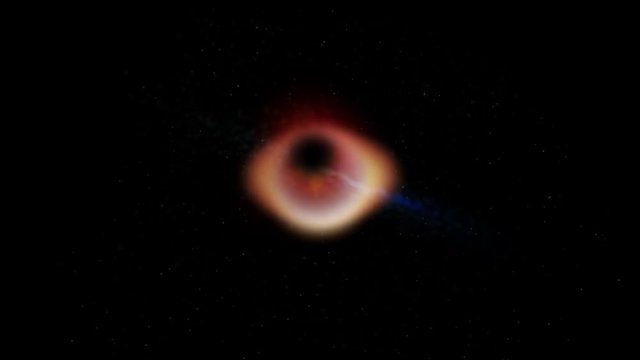
- –M87 contains a central Supermassive black hole (M87*) with a mass of about 6.5 billion solar masses, imaged directly in 2019 by the Event Horizon Telescope (EHT), a global array using Very Long Baseline Interferometry. The EHT results revealed a ring-like structure surrounding a “shadow,” providing the first direct visual evidence of a black hole. (See
EHT press release and the peer‑reviewed paper
ApJL, Paper I.)
- –Follow‑up EHT analyses showed the ring in polarized light, tracing strong magnetic fields at horizon scales, and documented year‑to‑year variability in the ring’s bright crescent orientation (“wobbling shadow”) using archival observations from 2009–2017. These studies constrain accretion-flow physics and magnetic geometry near the event horizon. (See
ALMA/EHT polarization release,
MIT News on polarization,
NSF wobbling-shadow summary.)
Relativistic jet and multiwavelength outflows
- –M87 launches a prominent one-sided Relativistic jet extending thousands of light-years, visible in optical/UV images and across the spectrum. Hubble resources document an optical jet length of roughly 5,000 light-years (with radio structures extending to ∼100,000 light-years), with knots and shock-like features that evolve over time. (See
Hubble time‑lapse/“space slinky”.)
- –X‑ray observations with the Chandra X-ray Observatory reveal a knotty, shock‑energized jet and hot gas affected by the active nucleus, with apparent superluminal motions in some features due to projection effects. These data probe particle acceleration and jet dynamics from ∼hundreds to tens of thousands of light-years. (See
Chandra 2001 jet image and description, and
Chandra 2020 analysis of jet knots and motions.)
- –In the near‑infrared, new JWST/NIRCam imaging isolates the jet against the galaxy’s starlight, resolving substructure in features such as HST‑1 and reporting a faint counter‑jet, refining constraints on synchrotron emission and jet geometry. (See Röder et al., “The infrared jet of M87 observed with JWST,”
Astronomy & Astrophysics preprint.)
Observation history
- –M87 was recorded by Charles Messier in 1781 and later entered as NGC 4486; its fame as a radio galaxy is reflected in the designation Virgo A/3C 274. These identifiers and historical notes are compiled by NASA/IPAC and are summarized for general readers by Encyclopaedia Britannica. (See
Britannica: M87 overview.)
- –The optical jet was first reported in 1918 by Heber D. Curtis, who described a “curious straight ray” emerging from the nucleus on Lick Observatory photographs; this early recognition of an extragalactic jet presaged later multiwavelength studies. (See Linda Hall Library’s historical summary with Curtis’s quotation:
Heber Curtis profile.)
- –Radio imaging and very‑long‑baseline studies by NRAO facilities (VLA/VLBA) helped trace jet collimation near the core and revealed large‑scale radio structures powered by the active nucleus. (See
NRAO press release on jet formation region and NASA’s summary of the VLBA/VLA results and context.
- –Hubble imaging in the 1990s provided key evidence for a central massive dark object via gas‑disk kinematics and resolved the jet’s UV/optical structure, supporting the presence of a central black hole later measured precisely by the EHT. (See
Instrumentation and techniques
- –M87 has been a cornerstone target for horizon‑scale interferometry with the EHT, which synthesizes a planet‑sized aperture using Very Long Baseline Interferometry and an international network of radio observatories, including ALMA, to reach microarcsecond resolution. (See
- –Optical/UV imaging and time‑domain studies with the Hubble Space Telescope (WFPC2, ACS, FOC, STIS) have mapped jet knots and flaring regions (e.g., HST‑1) and surveyed the galaxy’s globular‑cluster system. (See
- –X‑ray imaging with Chandra has traced hot gas, cavities, and jet activity linked to the active galactic nucleus, complementing radio and optical data sets for a multiwavelength view of feedback. (See