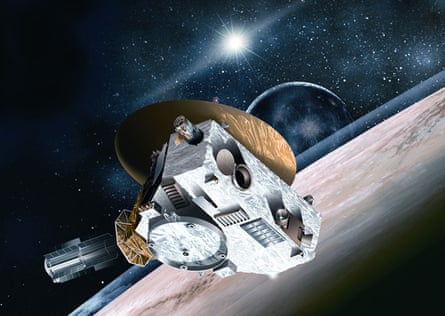
New Horizons is a NASA robotic interplanetary spacecraft that conducted the first flyby of Pluto in 2015 and a subsequent flyby of the Kuiper Belt object Arrokoth in 2019, becoming the first mission to explore two distinct Kuiper Belt targets up close. New Horizons was launched on January 19, 2006, and remains an active mission operating at the outer edge of the Kuiper Belt. (New Horizons – NASA Science,
https://science.nasa.gov/mission/new-horizons/)
Spacecraft and design
New Horizons was built and is operated by the Johns Hopkins University Applied Physics Laboratory (APL) with science leadership by Southwest Research Institute; it was the first mission in NASA’s New Frontiers program and is led by principal investigator Alan Stern. (New Horizons – NASA Science, https://science.nasa.gov/mission/new-horizons/)
The spacecraft has a launch mass of about 478 kg and uses a 2.1 m high‑gain antenna for communications; electrical power is provided by a single GPHS‑RTG that supplied roughly 250 W at launch, decaying to about 200 W by the Pluto encounter. (New Horizons – NASA Science, https://science.nasa.gov/mission/new-horizons/; Power: Radioisotope Thermoelectric Generators – NASA RPS,
https://science.nasa.gov/planetary-science/programs/radioisotope-power-systems/power/)
Scientific instruments
New Horizons carries seven instruments: the Ralph visible/infrared imager-spectrometer (MVIC and LEISA), Alice ultraviolet imaging spectrograph, REX radio science experiment integrated with the telecom system, LORRI high‑resolution panchromatic camera, SWAP solar wind instrument, PEPSSI energetic particle spectrometer, and the Venetia Burney Student Dust Counter (SDC). (New Horizons – NASA Science, https://science.nasa.gov/mission/new-horizons/; PDS Instrument Host summary,
https://pds.nasa.gov/ds-view/pds/viewHostProfile.jsp?INSTRUMENT_HOST_ID=NH)
Ralph’s LEISA and MVIC mapped surface composition and temperature (e.g., nitrogen, methane, carbon monoxide ices), including “Charon-light” mapping of Pluto’s night side. (NASA Goddard, https://www.nasa.gov/missions/nasa-goddard-involved-in-new-horizons-from-start/)
Alice profiled atmospheric composition via solar and stellar occultations, detecting nitrogen and hydrocarbons and revealing a colder, more compact upper atmosphere than expected. (NASA/JPL Photojournal PIA20590, https://photojournal.jpl.nasa.gov/catalog/PIA20590; NASA Science image page,
https://science.nasa.gov/photojournal/first-stellar-occultations-shed-additional-light-on-plutos-atmosphere/)
LORRI provided the highest‑resolution images; instrument design and performance are described by Cheng et al. (2007). (arXiv:0709.4278, https://arxiv.org/abs/0709.4278)
SDC, the first student‑built instrument on a planetary mission, measures interplanetary and Kuiper Belt dust along the trajectory. (NASA – Dusty hints of extended Kuiper Belt, https://www.nasa.gov/missions/new-horizons/nasas-new-horizons-detects-dusty-hints-of-extended-kuiper-belt/)
Mission profile
New Horizons launched on January 19, 2006, 19:00:00 UTC, on an Atlas V 551 with a Star‑48B upper stage, achieving the highest Earth‑relative launch speed to date (~36,400 mph). It passed lunar distance in about nine hours. (New Horizons – NASA Science, https://science.nasa.gov/mission/new-horizons/; “15 Years Ago: New Horizons Launched,” NASA,
https://www.nasa.gov/history/15-years-ago-new-horizons-launched-to-pluto-and-beyond/)
A gravity‑assist flyby of Jupiter on February 28, 2007, increased heliocentric speed by roughly 9,000 mph and shortened the cruise time to Pluto by several years; the encounter also returned Jupiter system science. (NASA release Jan. 18, 2007, https://www.nasa.gov/news-release/nasa-spacecraft-en-route-to-pluto-prepares-for-jupiter-encounter/; NASA release Feb. 28, 2007,
https://www.nasa.gov/news-release/nasa-spacecraft-gets-boost-from-jupiter-for-pluto-encounter/)
To save wear and cost, the spacecraft pioneered long‑duration “electronic hibernation” during cruise, with annual checkouts. (NASA – Exploring the Unexplored, https://www.nasa.gov/missions/new-horizons/exploring-the-unexplored-new-horizons-mission-to-pluto/)
Pluto system encounter (2015)
Closest approach occurred at 11:49 UTC on July 14, 2015, at about 7,800 km above Pluto’s surface; Charon flyby distance was ~28,800 km. (New Horizons – NASA Science, https://science.nasa.gov/mission/new-horizons/)
Initial results published in Science documented diverse geology (including the volatile‑ice plain Sputnik Planitia with convection and glacial flow), a likely water‑ice crust, multi‑layer atmospheric haze, and a surface pressure near ~10 microbar. (Science, “The Pluto System: Initial Results,” 350(6258), 2015, DOI 10.1126/science.aad1815, https://doi.org/10.1126/science.aad1815)
Alice and REX occultations revealed a colder, more compact upper atmosphere and a nitrogen escape rate far lower than many pre‑encounter models, with detailed vertical temperature and pressure profiles down to a cold near‑surface boundary layer. (NASA/JPL Photojournal PIA20590, https://photojournal.jpl.nasa.gov/catalog/PIA20590; DLR overview of REX results,
https://www.dlr.de/en/latest/news/2020/03/20200713_five-years-since-the-new-horizon-flyby-of-pluto)
Downlink of ~6.25 gigabytes of Pluto system data, restricted by long distances and X‑band limits, took until October 25, 2016, with typical rates of about 1–4 kb/s via the Deep Space Network. (New Horizons – NASA Science, https://science.nasa.gov/mission/new-horizons/; NASA status note on intensive downlink,
https://www.nasa.gov/general/nasas-new-horizons-spacecraft-begins-intensive-data-downlink-phase/)
Arrokoth flyby (2019)
New Horizons flew past Arrokoth (486958; formerly 2014 MU69) on January 1, 2019, the most distant close exploration to date, returning images that revealed a bilobate “contact binary” with uniform red color. (New Horizons – NASA Science, https://science.nasa.gov/mission/new-horizons/; NASA naming announcement,
https://www.nasa.gov/solar-system/far-far-away-in-the-sky-new-horizons-kuiper-belt-flyby-object-officially-named-arrokoth/)
Analyses published in 2020 indicate Arrokoth formed by gentle merger within a locally collapsing particle cloud in the solar nebula, providing evidence for planetesimal formation by cloud collapse rather than hierarchical accretion. (Science 2020 via PubMed, https://pubmed.ncbi.nlm.nih.gov/32054695/; NASA feature “Arrokoth Revealed,”
https://www.nasa.gov/missions/new-horizons/arrokoth-revealed-a-first-in-depth-look-at-a-pristine-world/)
Extended mission and current status
On October 1, 2024, New Horizons passed 60 AU from the Sun; beginning in FY 2025, NASA directed the mission to emphasize heliophysics and dust science while preserving the possibility of a future distant Kuiper Belt target if one is found. (New Horizons – NASA Science, https://science.nasa.gov/mission/new-horizons/; NASA announcement, Sept. 29, 2023,
https://www.nasa.gov/missions/new-horizons/nasas-new-horizons-to-continue-exploring-outer-solar-system/)
In 2024 the SDC reported elevated dust levels between ~45–55 AU, hinting the Kuiper Belt may extend farther or include an additional outer component; operations are planned to continue as the spacecraft traverses the outer Kuiper Belt in the late 2020s. (NASA – Dusty hints of extended Kuiper Belt, https://www.nasa.gov/missions/new-horizons/nasas-new-horizons-detects-dusty-hints-of-extended-kuiper-belt/; The Marshall Star highlighting extension through 2028–2029,
https://www.nasa.gov/centers-and-facilities/marshall/the-marshall-star-231004/)
Communications and navigation
Communications use X‑band via the 2.1 m high‑gain antenna to NASA’s Deep Space Network, with very low data rates at outer‑solar‑system distances (order 1–4 kb/s during Pluto downlink) and one‑way light times of several hours. (NASA status note on intensive downlink, https://www.nasa.gov/general/nasas-new-horizons-spacecraft-begins-intensive-data-downlink-phase/; New Horizons – NASA Science,
https://science.nasa.gov/mission/new-horizons/)
The spacecraft set the record for the highest launch speed relative to Earth (~36,400 mph), later boosted at Jupiter; cruise operations included long hibernation periods that reduced DSN load and spacecraft wear. (New Horizons – NASA Science, https://science.nasa.gov/mission/new-horizons/; NASA – Exploring the Unexplored,
https://www.nasa.gov/missions/new-horizons/exploring-the-unexplored-new-horizons-mission-to-pluto/)
Management and team
APL built and operates the spacecraft and mission, Southwest Research Institute leads science operations and encounter planning, and NASA’s Marshall Space Flight Center manages New Frontiers program oversight. (NASA – Dusty hints of extended Kuiper Belt, https://www.nasa.gov/missions/new-horizons/nasas-new-horizons-detects-dusty-hints-of-extended-kuiper-belt/; The Marshall Star,
https://www.nasa.gov/centers-and-facilities/marshall/the-marshall-star-231004/)