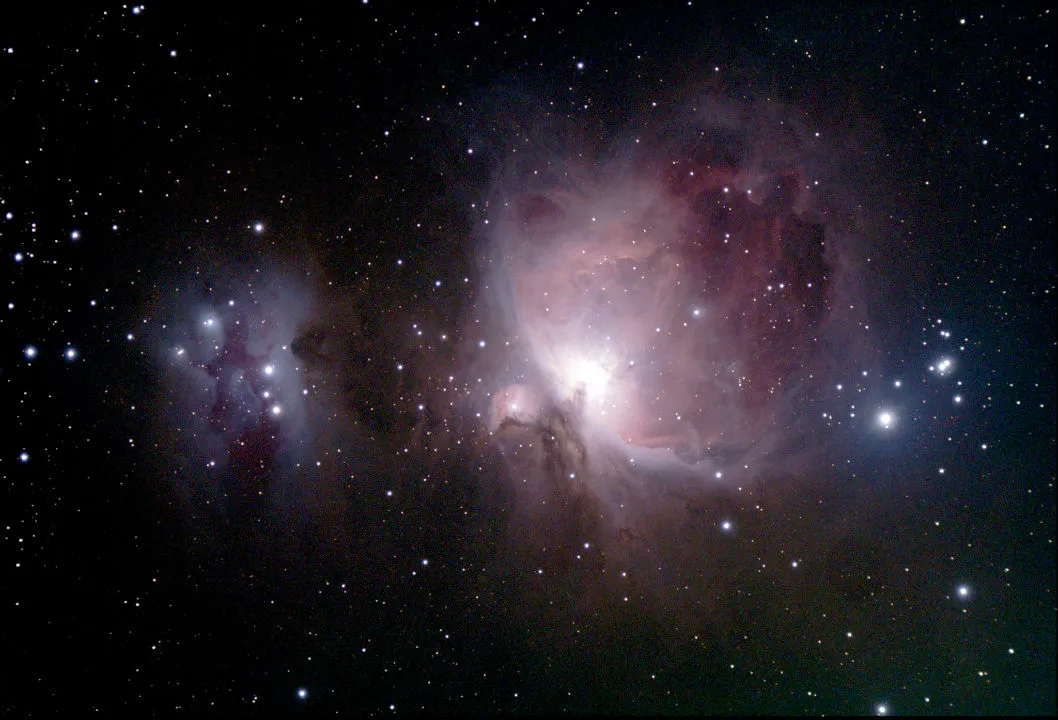
The Orion Nebula (Messier 42; NGC 1976) is a luminous H II region and stellar nursery situated in the Orion constellation, forming part of the larger Orion Molecular Cloud Complex and visible as the “middle star” of Orion’s sword to the unaided eye. According to Encyclopaedia Britannica, the nebula lies about 1,350 light‑years from Earth and contains a dense cluster of hot, young stars, while NASA/ESA imaging resources often round its distance to about 1,500 light‑years, reflecting method and field differences across studies. Britannica;
NASA Science.
Location, designation, and distance
M42/NGC 1976 occupies the sword region of Orion and is cataloged in the Messier catalog as object 42; the adjacent De Mairan’s Nebula is cataloged separately as Messier 43. Historically and observationally, the nebula’s quoted distance spans a range because different tracers sample different depths and substructures of the Orion complex. A Very Long Baseline Array parallax of Orion Nebula Cluster members yields 414 ± 7 pc (≈1,350 light‑years), providing a widely used geometric benchmark, while several Hubble public resources describe the field at roughly 1,500 light‑years for outreach and image‑scale context. Astronomy & Astrophysics;
NASA Science.
Physical nature and ionization structure
The Orion Nebula is a prototypical blister H II region: a thin layer of ionized hydrogen on the near side of a giant molecular cloud, photoionized by massive stars and bounded by neutral and molecular gas. A comprehensive review emphasizes a concave, blister‑like geometry in front of the OMC‑1 cloud, with dense substructures and an ionization front that transitions to the photodissociation region (PDR) known as the Orion Bar. Annual Review of Astronomy and Astrophysics. Spectroscopic mapping finds characteristic electron temperatures near 9,200 ± 400 K in the bright Huygens region and reveals large‑scale flows and localized dynamical features.
arXiv (García‑Díaz et al. 2008). The Orion Bar PDR shows stratified layers (C+ → C → CO) and gas flows across the ionization front; recent JWST Early Release Science observations (PDRs4All) detected the S I 25.249 μm line and constrained sulfur abundances and depletions with unprecedented sensitivity.
Astronomy & Astrophysics;
Astronomy & Astrophysics.
Ionizing sources and the Trapezium
At the nebula’s core lies the compact Trapezium Cluster (θ¹ Orionis system), whose most massive member, θ¹ Ori C, dominates the ionization and mechanical feedback. Spectroscopic and interferometric studies show θ¹ Ori C is a multiple system whose O‑type primary supplies the bulk of the Lyman‑continuum photons that carve the H II cavity and drive photoevaporation of nearby disks. Astronomy & Astrophysics;
MNRAS. The Orion Nebula Cluster (ONC) around the Trapezium contains thousands of young stars with a mean age of roughly 1–2 Myr and evidence for a few‑Myr intrinsic age spread, as inferred from photometric and spectroscopic surveys.
A&A;
arXiv (Reggiani et al. 2011).
Protoplanetary disks (proplyds) and feedback
The Orion Nebula is the archetype for externally irradiated protoplanetary disks (“proplyds”), many of which were first resolved with the Hubble Space Telescope. Early HST imaging identified numerous tear‑drop–shaped, externally ionized disks with bright cusps facing θ¹ Ori C and cometary tails pointing away, direct evidence of photoevaporative flows. NASA Science;
ESA/Hubble. A uniform HST/ACS census cataloged about 178 bright proplyds with tails, 28 silhouettes, and other related morphologies across the Huygens region, a figure that remains a reference sample.
arXiv (Ricci, Robberto & Soderblom 2008). Millimeter observations demonstrate that disks close to θ¹ Ori C are strongly depleted in mass compared to those farther away, consistent with rapid external photoevaporation in extreme‑UV environments, whereas a wide range of disk masses persists at larger separations.
arXiv (Mann et al. 2014). Physical models and spectroscopy of ionized flows show far‑UV heating of disk surfaces and acceleration to ionized winds, matching observed cusp/tail morphologies and line diagnostics.
MNRAS.
Embedded sources, outflows, and shocks
Behind M42, the OMC‑1 region hosts the BN/KL complex and an explosive, ≈500‑year‑old outflow whose energetics and proper motions indicate the decay of a non‑hierarchical massive multiple system as a plausible driver. arXiv (Bally et al. 2010). The field also contains prominent Herbig–Haro objects such as HH 1/2, where HST imaging and spectroscopy reveal shocks with components moving at >400 km s⁻¹, tracing jets from embedded protostars interacting with the surrounding medium.
NASA Science;
NASA Science.
Subregions and associated features
The northeastern extension M43 (De Mairan’s Nebula) is a smaller H II region ionized predominantly by NU Orionis, often described as a “miniature” Orion Nebula adjacent to the main cavity and separated by a dust lane. STScI. The larger complex includes the Extended Orion Nebula, the Veil foreground absorbing layer, and the Orion Bar Photodissociation region, all mapped in detail across optical, infrared, and radio wavelengths in modern surveys.
Astronomy & Astrophysics;
Annual Review of Astronomy and Astrophysics.
Multiwavelength surveys
A Hubble optical mosaic assembled from hundreds of ACS images resolved stellar content, brown‑dwarf candidates, and ionization structures over a field comparable to the full Moon’s apparent size, enabling proper‑motion studies and low‑mass census work. NASA Science. Deep Chandra observations (the Chandra Orion Ultradeep Project, COUP) detected more than 1,600 X‑ray point sources across the ONC and embedded populations, providing the most comprehensive view of magnetic activity in a young cluster and robust membership lists for statistical studies.
ApJS (catalog summary);
Penn State summary. Recent JWST observations of the Orion Bar with NIRCam and MIRI have refined our understanding of PDR chemistry, gas dynamics, and dust properties at sub‑arcsecond resolution, including first detections of key neutral sulfur lines and detailed stratification tests.
Astronomy & Astrophysics.
Observational history
The Orion Nebula was first recorded telescopically in 1610 by Nicolas‑Claude Fabri de Peiresc; Christiaan Huygens made the first detailed sketch in 1656, and Charles Messier included it in his 1771 catalog (observed March 4, 1769) as M42 to help distinguish nebulae from comets. Britannica;
ESO. The first successful astrophotograph of a nebula—Henry Draper’s image of M42—was obtained in 1880, inaugurating modern quantitative studies of emission nebulae.
Britannica.