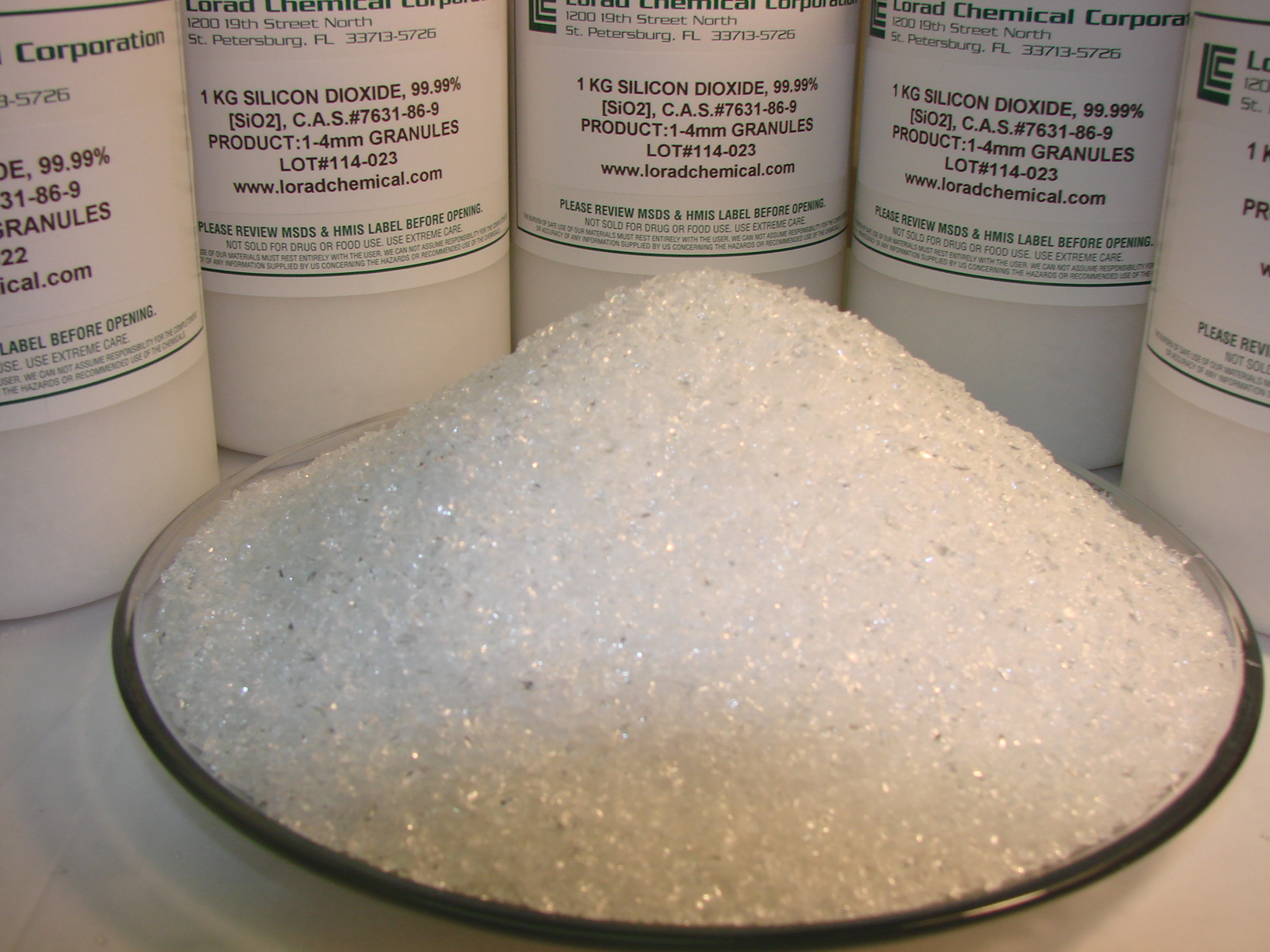
Silicon dioxide (chemical formula SiO2) is an inorganic oxide of Silicon that occurs naturally and is produced synthetically for numerous industrial uses. In nature it is abundant as quartz and as a major constituent of sands and many rocks, while synthetic forms include fused silica, fumed silica, and silica gel. The molecular weight is about 60.1 g·mol⁻¹, and crystalline quartz has a density near 2.65 g·cm⁻³, whereas vitreous (fused) silica is ~2.20 g·cm⁻³. Silica minerals are hard, brittle, electrically insulating, and typically colorless when pure; the NIOSH Pocket Guide lists SiO2 as a colorless, odorless solid with formula SiO2 and molecular weight 60.1.
CDC/NIOSH.
Composition and structure
Silicon dioxide consists of a continuous covalent network built from corner-sharing SiO4 tetrahedra (each silicon coordinated to four oxygens), producing a three‑dimensional framework responsible for its hardness and chemical durability. Britannica. Under very high pressure (e.g., in impact structures), stishovite forms, in which silicon is octahedrally coordinated by six oxygens, a distinct structure with density around 4.28 g·cm⁻³.
Britannica.
Polymorphs and forms
The principal crystalline polymorphs are Quartz (α‑quartz at ambient conditions), tridymite, cristobalite, coesite, and stishovite; natural or synthetic amorphous forms include vitreous (fused) silica, lechatelierite, and opal. Britannica. Fused silica is an amorphous glass with refractive index nd ≈ 1.458 at 587.6 nm and dielectric constant ~3.8 at 1 MHz, 20 °C.
Heraeus Suprasil data via Photonics Online;
Britannica, industrial glass properties.
Occurrence in the Earth and geology
Silica is a major component of the continental crust and the dominant constituent of many sands and silicate rocks; quartz is the stable SiO2 polymorph at Earth’s surface and is widely distributed in igneous, sedimentary, and metamorphic settings. Britannica. For industrial supply and use, the U.S. Geological Survey tracks “industrial sand and gravel (silica)” for glassmaking, foundry, hydraulic fracturing, and other applications.
United States Geological Survey;
USGS Mineral Commodity Summaries 2025.
Physical properties
Quartz (α‑quartz) has Mohs hardness 7 and density ~2.651 g·cm⁻³; vitreous silica has density ~2.203 g·cm⁻³ and refractive index near 1.459 (sodium D line). Britannica;
Britannica, properties table for oxide glasses. Fused silica shows a softening point around 1,580–1,670 °C and very low linear thermal expansion (~5.5 × 10⁻⁷ K⁻¹), which contribute to its thermal shock resistance.
Britannica, industrial glass. Manufacturer data for synthetic fused silica (e.g., Corning HPFS and Heraeus Suprasil) give nd ≈ 1.458–1.4585 at 587.6 nm and document deep-UV to IR transmission.
Heraeus/Photonics Online;
Corning HPFS overview.
Chemical reactivity
Silicon dioxide is chemically durable and insoluble in water at neutral pH, but it is attacked by hydrofluoric acid to form hexafluorosilicate in solution, a reaction exploited in microfabrication etching of SiO2. [Greenwood & Earnshaw, Chemistry of the Elements](book://N. N. Greenwood|Chemistry of the Elements|Butterworth‑Heinemann|1997). Strong bases (hot aqueous alkali) can dissolve silica and glass to yield silicate solutions (“water glass”). Britannica, amorphous solids—properties of oxide glasses. At high temperatures, reduction of SiO2 with carbon can produce elemental silicon and carbon monoxide, a process foundational to silicon metallurgy. [Greenwood & Earnshaw](book://N. N. Greenwood|Chemistry of the Elements|Butterworth‑Heinemann|1997).
Industrial production and processing
Amorphous fused silica is manufactured by chemical vapor deposition or flame hydrolysis of chlorosilanes (e.g., SiCl4), yielding high‑purity transparent glass for optics and semiconductor uses. Corning (HPFS) manufacturing overview. Industrial silica (high‑SiO2 sand and gravel) is mined by open pit or dredging for glass, foundry, hydraulic fracturing, and other applications.
USGS silica statistics.
Applications
- –Glass and ceramics: Commercial Glass relies on silica as a network former. Soda–lime–silica glass, the most common type, is typically ~70–75% SiO2 with Na2O and CaO added to lower working temperatures and stabilize the network.
Britannica, soda‑lime glass;
- –Construction materials: Silica is the dominant component of most sands used in aggregates for Concrete and in mortars; within Portland cement chemistry, silica participates in calcium silicate phases that hydrate to calcium‑silicate‑hydrate binder.
- –Adsorbents and desiccants: Silica gel is a common porous adsorbent used for drying gases and liquids and in chromatography; in IUPAC terminology it is a typical inorganic oxide adsorbent.
IUPAC Gold Book—Inorganic oxide adsorbent.
- –Optics and photonics: Fused silica optics exploit low thermal expansion and broad spectral transmission; nd ≈ 1.458 at 587.6 nm is representative for many synthetic grades.
Heraeus/Photonics Online;
- –Microelectronics: Thermally grown SiO2 on silicon is a foundational gate dielectric and surface passivation layer in Semiconductor device fabrication; oxidation kinetics are described by the Deal–Grove model. [Deal & Grove, 1965](journal://Journal of Applied Physics|General Relationship for the Thermal Oxidation of Silicon|1965); [S. M. Sze & K. K. Ng, Physics of Semiconductor Devices](book://S. M. Sze|Physics of Semiconductor Devices (3rd ed.)|Wiley|2007). The relative permittivity of SiO2 is ~3.8–3.9 at MHz frequencies, with dielectric breakdown fields on the order of MV·cm⁻¹.
- –Food technology: Amorphous silicon dioxide is permitted as a direct food additive (e.g., anticaking agent) subject to conditions including not exceeding 2% by weight of the food.
21 CFR §172.480 (eCFR via LII).
Health and safety
Inhalation of respirable crystalline silica (quartz, cristobalite, tridymite) can cause silicosis and increases lung cancer risk; the International Agency for Research on Cancer classifies respirable crystalline silica dust as carcinogenic to humans (Group 1), while amorphous silica was not classifiable (Group 3) in its evaluations. IARC Monographs, Volume 68 (1997) summary via NCBI Bookshelf;
IARC publication page. The OSHA permissible exposure limit (PEL) for respirable crystalline silica in general industry is 50 µg·m⁻³ as an 8‑hour TWA, with an action level of 25 µg·m⁻³; OSHA issued final rules to this effect in 2016.
OSHA standard 29 CFR 1910.1053;
OSHA Final Rule, Mar. 25, 2016. In mining, MSHA finalized a similar limit of 50 µg·m⁻³ (action level 25 µg·m⁻³) on April 18, 2024.
MSHA final rule, 2024. NIOSH recommends a REL of 0.05 mg·m⁻³ (50 µg·m⁻³) TWA for respirable crystalline silica.
CDC/NIOSH Pocket Guide.
Standards, terminology, and reference data
Authoritative chemical terminology recognizes numerous silica‑based materials, including sol‑gel silica and organically modified silica, used across coatings, optics, and catalysis. IUPAC Gold Book—sol‑gel silica;
IUPAC Gold Book—organically modified silica. Reference property data for defined chemical species are curated by the NIST Chemistry WebBook and related Standard Reference Data resources.
NIST Chemistry WebBook program page.
Related chemical interactions and handling
Contact with Hydrofluoric acid rapidly attacks SiO2, generating soluble hexafluorosilicates and posing special corrosion and toxicity hazards in laboratory and industrial settings; glass should not be used with HF. [Greenwood & Earnshaw](book://N. N. Greenwood|Chemistry of the Elements|Butterworth‑Heinemann|1997). Workplace controls for respirable crystalline silica include engineering controls, exposure assessment, respiratory protection, medical surveillance, and hazard communication as specified in OSHA’s standards and guidance. OSHA 29 CFR 1910.1053;
OSHA FAQs for general industry.