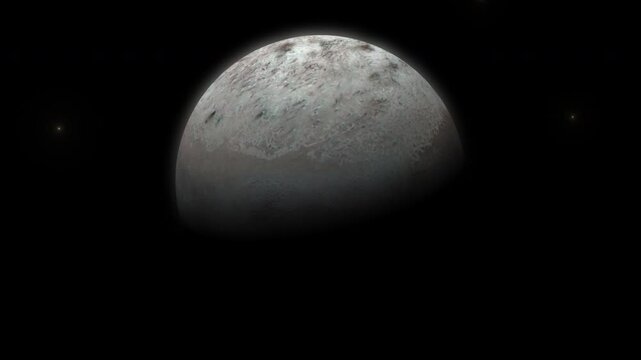
Triton is the largest natural satellite of Neptune, discovered on October 10, 1846 by William Lassell, and is unique among large moons for its retrograde, highly inclined orbit that strongly indicates capture from the Kuiper Belt. According to NASA’s overview, Triton is tidally locked to Neptune and likely originated as a Kuiper Belt object that was later captured by Neptune’s gravity. NASA Science. (
science.nasa.gov) Britannica lists Triton’s semimajor axis at about 354,759 km, an orbital period of 5.877 days, and a tilt exceeding 157° relative to Neptune’s equator, producing extreme seasons that last roughly 41 years each.
Britannica. (
britannica.com)
Size, mass, and composition
- –Voyager measurements and subsequent analyses give Triton a diameter of about 2,706 km, a mean radius of 1,353.4 km, a mass near 2.14 × 10^22 kg, and a mean density of roughly 2.06 g/cm³, implying a rock‑rich interior beneath extensive water‑ice and volatile‑ice layers.
Britannica. (
britannica.com) NASA notes a bright, nitrogen‑frosted surface with high reflectivity; Voyager 2 measured surface temperatures near −235 °C (≈38 K).
NASA Science and
NASA Photojournal. (
science.nasa.gov) In near‑infrared imagery from the James Webb Space Telescope, Triton appears exceptionally bright due to sunlight reflected from its nitrogen frost, outshining Neptune at these wavelengths.
NASA. (
nasa.gov)
Orbit, rotation, and seasons
- –Triton’s retrograde, nearly circular orbit and synchronous rotation (one face permanently toward Neptune) are well established; its extreme obliquity of the orbit relative to Neptune’s equator causes alternating decades‑long polar summers and winters.
Britannica. (
britannica.com) NASA summarizes that both poles alternately face the Sun because of Triton’s orbital inclination, a key driver of its volatile cycles.
NASA Science. (
science.nasa.gov)
Atmosphere and climate
- –Voyager 2 radio science found a tenuous, global nitrogen atmosphere with surface pressure around 14 microbar and methane as a trace gas, consistent with nitrogen frost in vapor‑pressure equilibrium near 38 K.
NASA History and
NASA Photojournal. (
nasa.gov) High‑resolution ground‑based spectroscopy later detected gaseous carbon monoxide alongside methane, confirming additional minor atmospheric constituents and active surface–atmosphere exchange.
Astronomy & Astrophysics. (
aanda.org) Recent stellar occultation analyses indicate that surface pressure in 2017 and 2022 was again near the 1989 value, about 14–15 microbar, implying modest long‑term variation across Triton’s prolonged southern summer.
Astronomy & Astrophysics. (
aanda.org)
Surface geology and activity
- –The only close reconnaissance, by Voyager 2 in August 1989, revealed a geologically young, sparsely cratered surface with plains, graben, and distinctive “cantaloupe” terrain—an array of rounded pits and hummocks commonly interpreted as diapiric overturn of the icy crust.
NASA JPL. (
jpl.nasa.gov) NASA resources describe additional smooth volcanic plains, mounds, and pits consistent with cryovolcanic resurfacing.
NASA Science. (
science.nasa.gov) During the flyby, Voyager imaged active geyser‑like plumes rising to about 8 km and drifting downwind for ~150 km, depositing dark streaks across the south polar terrain.
NASA JPL News. (
jpl.nasa.gov) The combination of active plumes, wind‑shaped streaks, and resurfaced plains makes Triton one of the few outer‑Solar‑System bodies with observed ongoing Cryovolcanism.
NASA Photojournal and
NASA JPL News. (
science.nasa.gov)
Interior and possible ocean
- –NASA’s summary and subsequent modeling indicate a differentiated body with a rocky core, an icy mantle, and volatile‑rich crust; the combination of radiogenic heat and tidal dissipation has been proposed to maintain a present or recent subsurface ocean.
NASA Science. (
science.nasa.gov) A widely cited analysis argues that Triton’s large orbital inclination could generate significant obliquity tides in a liquid layer, potentially powering recent geological activity and sustaining an ocean beneath the ice shell. [Icarus: “Powering Triton’s recent geological activity by obliquity tides: Implications for Pluto geology”](journal://Icarus|Powering Triton's recent geological activity by obliquity tides: Implications for Pluto geology|2015) and archived preprint.
UC eScholarship. (
escholarship.org)
Origin and capture
- –Triton’s retrograde orbit and density distinguish it from typical prograde, co‑accreted satellites and support capture from heliocentric orbit. A Science report contemporaneous with the Voyager encounter outlined a capture‑and‑tidal‑evolution scenario that also explains the disturbed state of Neptune’s satellites.
NASA Technical Reports Server (Science, 1989). (
ntrs.nasa.gov) A later mechanism invokes binary exchange capture, wherein Neptune disrupted a Triton‑binary system and retained Triton on a bound, initially eccentric orbit that later circularized. [Nature: “Neptune’s capture of its moon Triton in a binary–planet gravitational encounter”](journal://Nature|Neptune’s capture of its moon Triton in a binary–planet gravitational encounter|2006). See abstract access via ResearchGate.
ResearchGate. (
researchgate.net)
Future dynamical evolution
- –Classical tidal evolution models predict that Triton’s retrograde orbit is slowly decaying; for nominal parameters, Triton would cross Neptune’s Roche limit in roughly 3.6 billion years, likely disrupting into a dense ring.
Astronomy & Astrophysics (1989) via NASA Technical Reports Server. (
ntrs.nasa.gov)
Exploration
- –Voyager 2 remains the only spacecraft to have visited Triton, imaging about 40% of the surface and discovering its active plumes in August 1989.
NASA History and
NASA JPL News. (
nasa.gov) In 2022, Webb’s near‑infrared images highlighted Triton’s bright nitrogen‑frosted surface and captured multiple Neptunian moons in a single frame.
NASA. (
nasa.gov) NASA studied a Discovery‑class flyby concept, Trident, to map the unvisited terrain, probe for a subsurface ocean, and re‑observe plume fields; Trident advanced to Phase A in 2020 but was not selected in the June 2, 2021 Discovery down‑selection that chose the Venus missions DAVINCI and VERITAS.
NASA JPL and
NASA Press Release, Jun 2, 2021. (
jpl.nasa.gov)
