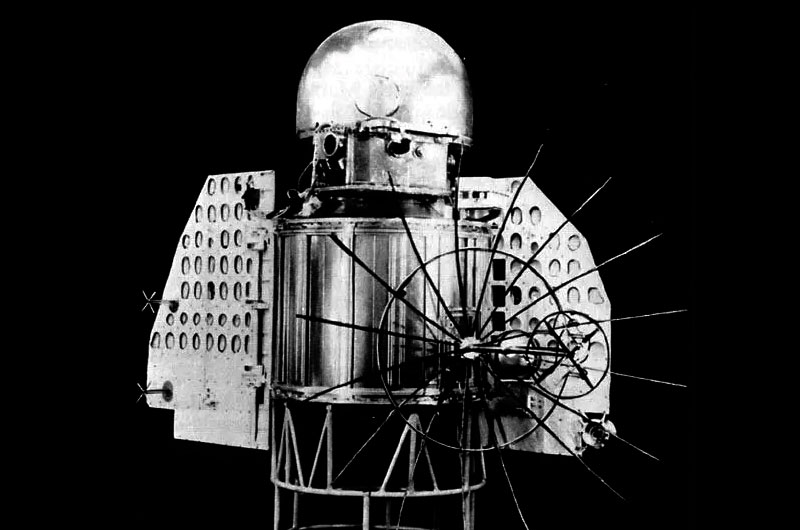
The Venera program was a sequence of spacecraft launched by the Soviet Union to investigate Venus between 1961 and 1984, achieving milestones that include the first soft landing on another planet, the first images from a planetary surface beyond the Moon, and high‑resolution orbital radar mapping of the Venusian surface. Ten probes transmitted from the surface and thirteen returned in‑situ atmospheric data, defining the modern baseline for Venus’s pressure, temperature, and composition. These efforts were engineered principally by Lavochkin. According to NASA’s GSFC/HEASARC program summary, the active span ran from February 1961 (first attempt) through July 1984 (final contact with Venera 16). NASA GSFC Imagine/HEASARC.
Origins and early attempts (1961–1966)
- –The program began with flyby attempts; Venera 1 (launched 12 February 1961) lost contact en route. Later, Venera 3 (launched 16 November 1965) impacted Venus on 1 March 1966, becoming the first human‑made object to contact the surface of another planet, though it returned no data after atmospheric entry.
Britannica,
NASA GSFC Imagine/HEASARC.
Atmospheric entries and first in‑situ measurements (1967–1969)
- –Venera 4 (launched 12 June 1967) performed the first in‑situ analysis of another planet’s atmosphere during its parachute descent on 18 October 1967, detecting a predominance of CO₂ and characterizing temperature/pressure profiles and the very weak magnetic field.
Venera 4 — Wikipedia summary with citations to primary sources.
- –Follow‑on probes Venera 5 and 6 (January 1969) transmitted for ~50 minutes during descent before succumbing to the extreme environment, refining atmospheric models.
First soft landing and surface conditions (1970–1972)
- –Venera 7 (launched 17 August 1970) executed the first successful soft landing on another planet on 15 December 1970, transmitting surface data for roughly 20–23 minutes; analysis indicated surface temperatures around 465–475 °C and pressures near 90–92 bar.
Space.com (NASA file quoted).
- –Venera 8 (1972) added geochemical data and confirmed light levels compatible with surface photography.
First images from a planetary surface beyond the Moon (1975)
- –Twin spacecraft Venera 9 and 10 (June 1975 launches) each comprised an orbiter and a hardened lander. Venera 9 landed on 22 October 1975 and returned the first images from the surface of another planet; Venera 10 followed on 25 October. Their orbiters were also the first spacecraft to be inserted into orbit around Venus.
NASA Science “First Look: Venus”,
DVIDS/NASA caption.
Advanced landers and color panoramas (1981–1982)
- –Venera 13 and 14 (launched 30 October and 4 November 1981) delivered robust descent modules that returned panoramic images and in‑situ geochemistry; Venera 13 survived 127 minutes and returned color panoramas from 7.5° S, 303° E, with basalt‑like compositions inferred from X‑ray fluorescence.
NASA NSSDCA — Venera 13 image caption,
- –A well‑known operational quirk occurred when Venera 14’s spring‑loaded penetrometer struck a discarded lens cap, compromising the soil compressibility test; NASA’s APOD notes the lens cap and penetrometer in frame.
NASA APOD,
- –Broader technical and program context for these campaigns is documented in the authoritative volume Soviet Robots in the Solar System. [Soviet Robots in the Solar System](book://Wesley T. Huntress Jr. and Mikhail Ya. Marov|Soviet Robots in the Solar System: Mission Technologies and Discoveries|Springer|2011).
Orbital radar mapping: Venera 15/16 (1983–1984)
- –The twin orbiters Venera 15 and 16 (1983) carried the first high‑resolution imaging radar systems flown to another planet, mapping roughly the northern quarter of Venus at ~1–2 km resolution, revealing tectonic and volcanic features under the global cloud deck.
Engineering and operations
- –Venera landers used highly pressurized, thermal‑buffered pressure vessels with limited instrument payloads to survive Venus’s ~460–475 °C and ~90‑bar surface environment for tens of minutes to a few hours.
- –Across the series, ten landers transmitted from the surface, and thirteen probes returned in‑situ atmospheric data, figures summarized by NASA’s HEASARC.
Related program: balloons and Halley flybys (Vega, 1984–1986)
- –Building directly on Venera hardware and know‑how, the Vega program launched twin spacecraft in December 1984 that each delivered a descent module and the first balloons ever deployed on another planet (June 1985), drifting for ~46 hours at ~54 km altitude before continuing to 1P/Halley in 1986.
NASA JPL news (Jan. 25, 1985),
NASA NTRS — The Venus Balloon Project,
CaltechAUTHORS (Science, 1986) overview of in‑situ measurements,
Legacy and subsequent plans
- –Venera established foundational knowledge of Venus’s atmosphere and surface—CO₂‑rich composition, lack of a global magnetic field, and extreme surface conditions—while pioneering techniques in planetary entry, landing, imaging, and orbital radar remote sensing.
- –Post‑Soviet proposals for a renewed Venus mission (commonly termed Venera‑D) have been studied intermittently; public program documents have placed any launch no earlier than the mid‑2030s.
Cross‑references
- –Subsequent and comparative missions include the U.S. Pioneer Venus project and [Magellan (spacecraft)], both central to Venus studies and mapping; Venera data remain a reference for interpreting later datasets.