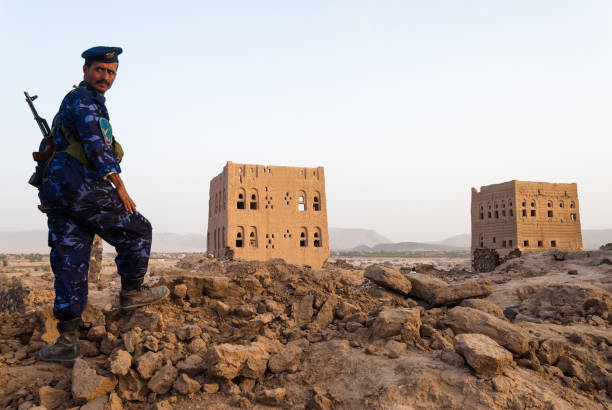
Yemen is a country in southwestern Asia occupying the southern end of the Arabian Peninsula, bordered by Saudi Arabia and Oman and fronting the Red Sea and Gulf of Aden; the de jure capital is Sana'a, while the internationally recognized government operates largely from Aden. According to the United Nations’ 2024 World Population Prospects, Yemen’s mid‑2025 population is projected at about 41.8 million, reflecting high fertility and decades of growth. The country’s area is 527,968 km², and it includes the Socotra Archipelago in the northwest Indian Ocean and islands in the southern Red Sea near the Bab el‑Mandeb strait. UN DESA – World Population Prospects 2024;
CIA World Factbook;
UNESCO – Socotra.
Geography and environment
- –Relief and climate: A narrow Tihāmah coastal plain rises sharply to temperate highlands that reach Jabal an‑Nabi Shuʿayb (3,666 m), then fall to upland plateaus merging with the Rubʿ al‑Khālī desert. Climate ranges from hot and humid along the west coast to temperate in the western mountains and arid in the east.
CIA World Factbook.
- –Strategic position: Yemen’s shores frame the Bab el‑Mandeb, a chokepoint linking the Red Sea and Gulf of Aden traversed by major energy and container routes.
- –Biodiversity: The Socotra Archipelago hosts exceptional endemism—about 37% of 825 plant species, 90% of reptiles, and 95% of land snails occur nowhere else—earning it World Heritage status.
UNESCO – Socotra.
- –Heritage sites: Yemen’s UNESCO‑listed properties include the Old City of Sana’a (1986), Old Walled City of Shibam (1982), Historic Town of Zabid (1993), Socotra Archipelago (2008), and the “Landmarks of the Ancient Kingdom of Saba, Ma’rib” (2023, inscribed in danger).
UNESCO press note.
History
- –Antiquity: South Arabian polities such as the Sabaean and Himyarite kingdoms prospered from frankincense and myrrh and irrigated the Ma’rib oasis with monumental hydrological works; Rome called the region Arabia Felix (Fortunate Arabia).
Britannica – Yemen.
- –Islam and medieval eras: Yemen adopted Islam in the 7th century; subsequent centuries saw Ayyubid and Rasulid rule and later intermittent Ottoman control, especially in the northwest.
- –Modern period and unification: The Yemen Arab Republic (North Yemen) emerged in 1962 after Ottoman decline, and the People’s Democratic Republic of Yemen (South Yemen) became independent from Britain in 1967; both states unified as the Republic of Yemen on 22 May 1990.
Politics and conflict since 2011
- –Uprising and war: Unrest in 2011 led to a transitional process. In 2014 the Houthi movement (Ansar Allah) seized Sana’a, and in March 2015 a Saudi‑led coalition intervened at the request of the internationally recognized government. UN Security Council Resolution 2216 (14 April 2015) demanded Houthi withdrawal from seized areas and the relinquishing of heavy arms.
UN Press on S/RES/2216;
UN document S/RES/2216 (2015).
- –Truce and new executive: A UN‑brokered truce that began in April 2022 significantly reduced large‑scale fighting, and on 7 April 2022 a Presidential Leadership Council (PLC) chaired by Rashad al‑Alimi assumed the executive powers of the presidency; the PLC is based primarily in Aden.
OSESGY/UN briefing;
Xinhua summary of decree;
Al Jazeera – inauguration.
- –Red Sea crisis: Beginning in late 2023, Houthi attacks on commercial shipping in the Red Sea and Gulf of Aden prompted coordinated U.S.–UK strikes on Houthi targets in 2024–2025 to protect navigation, underscoring the strait’s global importance.
U.S. DoD;
Reuters.
- –Mediation: The UN Special Envoy reported that, despite relative frontline calm since 2022, the risk of escalation persists and a UN‑facilitated roadmap aims at a nationwide ceasefire and intra‑Yemeni political process.
OSESGY/UN Geneva, 6 Mar 2025;
Humanitarian situation
- –Needs: For 2025, an estimated 19.5 million people require humanitarian assistance, with aid agencies appealing for about US$2.47 billion to target the most vulnerable.
- –Food insecurity and malnutrition: UN reporting in 2025 warns that acute hunger and child malnutrition remain critically high, especially along the western coast.
- –Public health: Yemen experienced the world’s largest recorded cholera outbreak (2017–2020), and transmission has persisted with major surges documented in 2024.
WHO news, 2017;
Government and society
- –System and authorities: The internationally recognized executive is the PLC (established 7 April 2022), while de facto Houthi authorities control Sana’a and much of the north; southern areas include actors such as the Southern Transitional Council alongside government forces.
- –People and religions: The population is predominantly Arab and overwhelmingly Muslim, with Sunni (primarily Shāfiʿī) and Zaydī Shia communities; minorities include small Christian, Baha’i, Hindu and Jewish populations.
- –Languages: Arabic is the official language; Soqotri (on Socotra) and Mehri in the east are also spoken.
Economy
- –Contraction and fragmentation: Real GDP per capita has fallen roughly 58% since 2015, amid the emergence of dual economic zones and competing monetary authorities. Oil export disruptions have strained public finances, and high inflation persists in Aden‑based areas.
World Bank – Yemen Overview (last updated Jul 25, 2025).
- –Sectors and resources: Yemen’s resources include petroleum, fish, and rock salt, but conflict and fuel shortages have crippled production and service delivery.
- –Energy access and renewables: Yemen has been described as the least electrified country in the Middle East; a 120‑MW solar plant in Aden (operational July 2024) has improved supply for households and facilities, with plans to expand.
- –Agriculture and crops: Qāt is widely cultivated in highland terraces; historically, Yemen exported coffee through the port of Mocha, embedding “mocha” in global coffee culture.
Culture and heritage
- –Urban heritage: Sana’a preserves hundreds of decorated multi‑storey tower houses; Shibam’s vertical mud‑brick architecture has been called the “Manhattan of the desert”; Zabid was a medieval capital with a long‑standing Islamic university.
- –Material culture and trade: Ancient South Arabian irrigation (e.g., Ma’rib Dam) and incense‑route commerce shaped settlement, language, and material culture for centuries.
Transport and strategic waterways
- –Ports and corridors: Aden and Al‑Hudaydah are principal seaports; road connectivity is frequently disrupted by conflict and terrain.
- –Maritime security: Threats to navigation since late 2023 triggered multinational naval operations and targeted strikes against Houthi capabilities to protect Red Sea shipping.
AP News.
Demographics and human development
- –Population: UN projections (2024 revision) place Yemen’s mid‑2025 population near 41.8 million, skewed young.
UN DESA – World Population Prospects 2024.
- –Human development: Yemen is in the low human‑development category and ranks among the lowest globally on HDI indicators, reflecting conflict‑driven reversals.
UNDP press note on 2023/24 HDR.