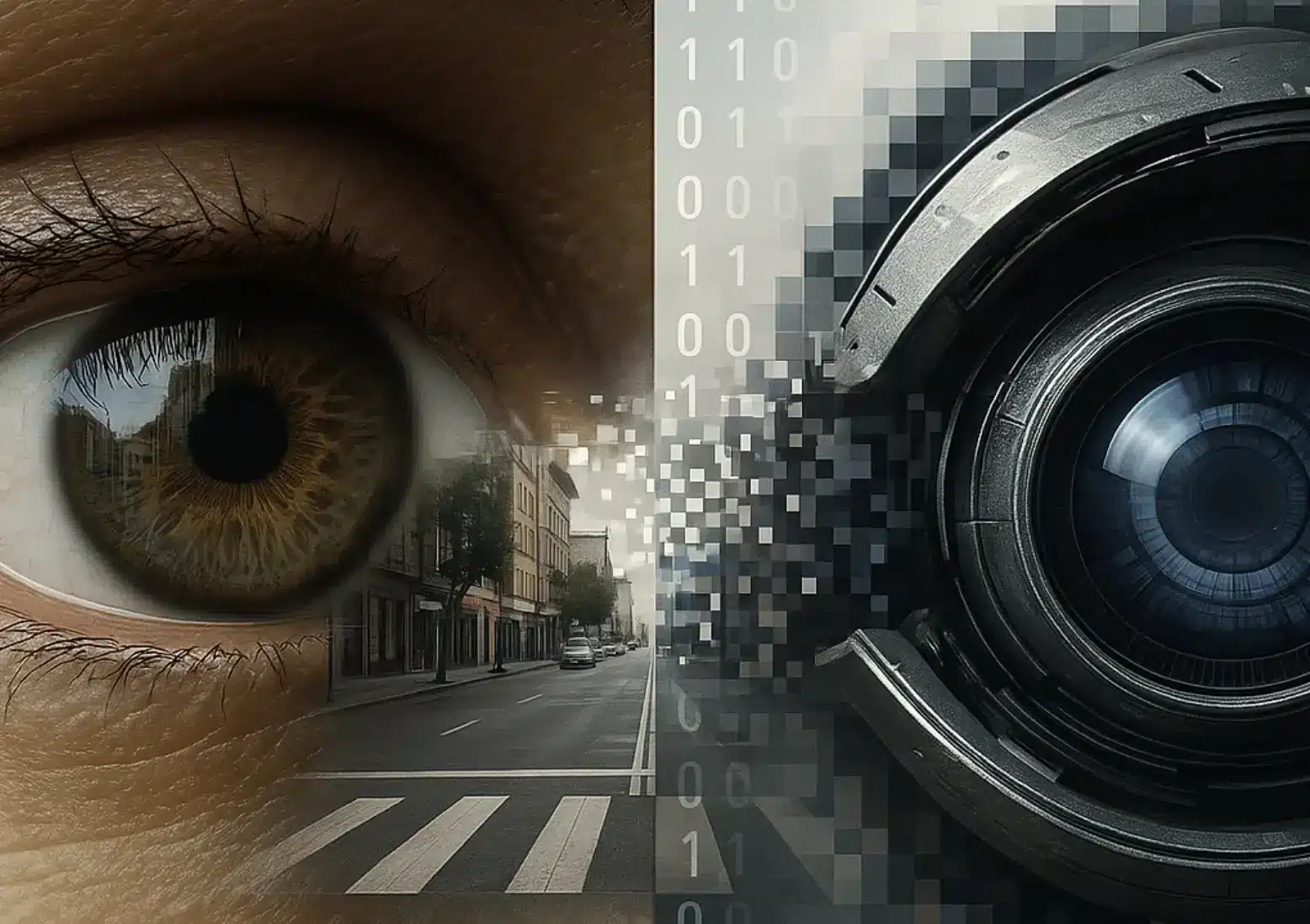
Computer vision is a subfield of Artificial Intelligence that studies how to extract, analyze, and act on information from digital images and video, encompassing tasks such as recognition, detection, segmentation, tracking, 3D reconstruction, and scene understanding. Authoritative overviews emphasize its dual foundations in image formation/geometry and statistical learning for robust perception in the wild, with widespread applications in industry and science. According to the editors at Encyclopaedia Britannica, the field develops algorithms that allow computers to “see” by identifying objects and patterns in digitized images; comprehensive textbooks such as Richard Szeliski’s Computer Vision: Algorithms and Applications provide the algorithmic and mathematical basis. [Szeliski, R.](book://Richard Szeliski|Computer Vision: Algorithms and Applications|Springer|2022)
Historical development
Foundational techniques date to the mid‑20th century. The Hough transform for line detection was patented by Paul Hough in 1962, later generalized for curves and adopted widely in vision. United States Patent 3,069,654;
Duda & Hart, 1972. In motion analysis, classic optical‑flow methods include Horn–Schunck’s global variational approach and the Lucas–Kanade local differential method, both introduced in 1981. [Horn & Schunck](journal://Artificial Intelligence|Determining optical flow|1981);
Lucas & Kanade.
A unifying computational theory of vision was articulated by David Marr, whose 1982 monograph framed vision in terms of levels of analysis (computational, algorithmic, implementational) and hierarchical representations from the 2.5D sketch to 3D object models. [Marr, D.](book://David Marr|Vision: A Computational Investigation into the Human Representation and Processing of Visual Information|MIT Press|1982); MIT Press Bookstore.
Feature‑based recognition advanced with scale‑invariant local descriptors such as SIFT, which offered robust keypoints across scale and rotation and proved effective for matching and object recognition. [Lowe, D. G.](journal://International Journal of Computer Vision|Distinctive Image Features from Scale‑Invariant Keypoints|2004).
Datasets, benchmarks, and the deep learning turn
Large annotated datasets and public challenges catalyzed rapid progress. ImageNet (introduced in 2009) provided millions of labeled images organized by the WordNet hierarchy and became the basis of the ImageNet Large Scale Visual Recognition Challenge (ILSVRC, 2010–2017). Deng et al., CVPR 2009;
Russakovsky et al., IJCV 2015. The 2012 ILSVRC marked a watershed when a deep convolutional neural network (“AlexNet”) dramatically reduced classification error, signaling the viability of large‑scale deep learning for vision.
Krizhevsky, Sutskever & Hinton, NeurIPS 2012.
Subsequent architectures improved optimization and accuracy, notably residual networks (ResNets) that introduced identity skip connections and won ILSVRC 2015. He et al., 2015. The Vision Transformer (ViT) later demonstrated that a pure transformer applied to image patches can match or surpass convolutional models when pretrained at scale.
Dosovitskiy et al., 2020. Beyond ImageNet, the MS COCO dataset emphasized objects in context with dense instance annotations, shaping detection and segmentation research.
Lin et al., 2014.
Core methods and tasks
- –Image classification and representation learning rely heavily on Convolutional Neural Network architectures; modern approaches also include self‑supervised pretraining and transformer‑based backbones. [Szeliski, R.](book://Richard Szeliski|Computer Vision: Algorithms and Applications|Springer|2022);
Dosovitskiy et al., 2020.
- –Object detection progressed from sliding‑window classifiers to end‑to‑end detectors such as YOLO, which reframed detection as single‑shot regression for real‑time performance.
Redmon et al., CVPR 2016.
- –Semantic and instance segmentation often use encoder–decoder networks; U‑Net popularized a symmetric contracting/expanding design with skip connections for precise localization, especially in biomedical imaging.
- –3D geometry, stereo, and multi‑view reconstruction draw on projective geometry, camera models, epipolar constraints, and bundle adjustment; a standard reference is Hartley & Zisserman’s text. [Hartley & Zisserman](book://Richard Hartley and Andrew Zisserman|Multiple View Geometry in Computer Vision (2nd ed.)|Cambridge University Press|2004);
Oxford VGG book page.
- –Motion analysis includes optical flow and feature tracking (e.g., Lucas–Kanade and KLT trackers) used in video understanding and visual odometry. [Horn & Schunck](journal://Artificial Intelligence|Determining optical flow|1981);
Lucas & Kanade.
Applications
Computer vision systems underpin quality inspection and guidance in manufacturing, content moderation and search, medical imaging (diagnosis and treatment planning), document understanding, agriculture, and perception stacks for autonomous systems and robotics. Introductory treatments and industrial summaries highlight the breadth of deployed use cases. Britannica;
IBM overview.
Research ecosystem and venues
Major peer‑reviewed journals include IEEE Transactions on Pattern Analysis and Machine Intelligence (TPAMI) and the International Journal of Computer Vision (IJCV), which publish core advances in recognition, 3D vision, and learning‑based perception. NLM Catalog entry for TPAMI. Flagship conferences are the International Conference on Computer Vision (ICCV, biennial in odd years), the European Conference on Computer Vision (ECCV, biennial in even years), and CVPR (annual), each featuring technical papers, tutorials, and workshops.
ICCV 2025 (Honolulu, Oct 19–23, 2025);
ECCV 2024 (Milan, Sep 29–Oct 4, 2024);
CVPR 2025.
Software and tools
Open‑source libraries accelerate research and deployment. OpenCV (Open Source Computer Vision Library), initiated in 2000 and maintained by the Open Source Vision Foundation, provides thousands of optimized algorithms with C++/Python interfaces and cross‑platform support, widely used in academia and industry. OpenCV About.
Data, evaluation, and societal considerations
Benchmark datasets and leaderboards have driven progress but can also introduce dataset bias that limits cross‑dataset generalization. A seminal study by Torralba and Efros quantified such biases and advocated improved evaluation protocols. Torralba & Efros, CVPR 2011. In sensitive applications such as face recognition, independent evaluations by NIST report measurable demographic differentials in error rates across many algorithms, underscoring the need for rigorous auditing, representative data, and appropriate governance.
NIST FRVT Demographic Effects (NISTIR 8280 and follow‑ups);
Summary page.
Relationship to adjacent fields
Computer vision is closely related to pattern recognition and image processing, which contribute statistical classification and signal filtering methods, respectively, and to robotics and graphics through perception–action loops and rendering/scene modeling. Standard references cover camera calibration, image formation, and inverse problems linking these areas. [Szeliski, R.](book://Richard Szeliski|Computer Vision: Algorithms and Applications|Springer|2022); [Hartley & Zisserman](book://Richard Hartley and Andrew Zisserman|Multiple View Geometry in Computer Vision (2nd ed.)|Cambridge University Press|2004).