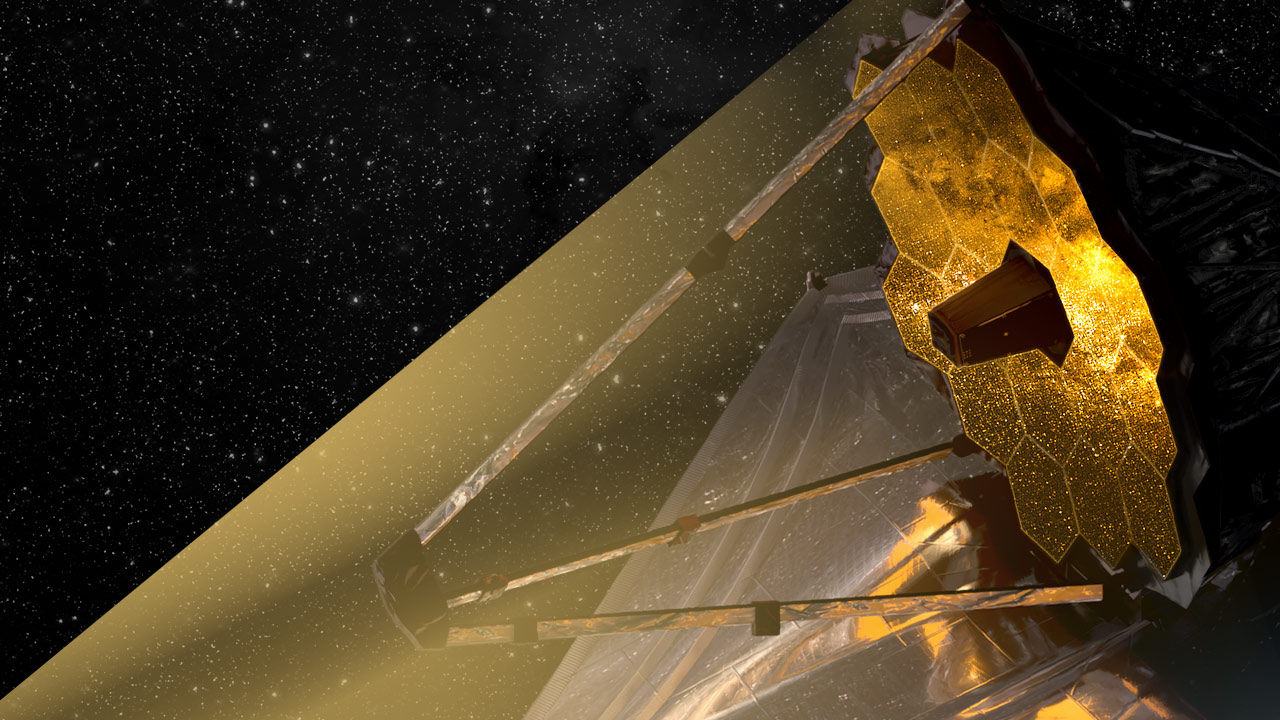
The James Webb Space Telescope (JWST) is a large space observatory optimized for infrared astronomy and operated as an international partnership between NASA, the European Space Agency, and the Canadian Space Agency. According to NASA, Webb launched on December 25, 2021, and began routine science operations in July 2022 after in‑space deployment and commissioning. NASA.
Design and objectives
JWST’s primary mirror measures 6.5–6.6 meters in diameter, is composed of 18 hexagonal gold‑coated beryllium segments, and provides about 25 square meters of light‑collecting area to enable observations from 0.6 to 28.5 microns. NASA. The mirror segments are 1.32 meters across and carry a ~100‑nanometer gold coating to maximize infrared reflectivity.
NASA. The observatory’s mission goals include probing the first luminous objects after the Big Bang, tracing galaxy assembly over cosmic time, studying the birth of stars and planetary systems, and characterizing exoplanet atmospheres.
NASA.
A five‑layer deployable sunshield of Kapton E, roughly 21.2 × 14.2 meters (about a tennis court), passively cools the telescope to below ~50 K, creating a hot–cold temperature drop of roughly 299–570 °C across the shield to enable ultra‑sensitive infrared measurements. NASA. The sun‑facing layers also include doped‑silicon coatings to improve thermal and electrical properties, and the stacked design minimizes conductive and radiative heat transfer.
NASA and
NASA.
Development and partnership
Webb was developed under NASA leadership with key hardware and launch contributions from ESA and CSA; ESA provided the Ariane 5 launch service, NIRSpec, and the MIRI optics assembly, while CSA provided the Fine Guidance Sensor (FGS) and the Near‑Infrared Imager and Slitless Spectrograph (NIRISS). STScI and
ESA. The Space Telescope Science Institute in Baltimore serves as the Science and Operations Center, coordinating proposal selection, operating the observatory, and archiving data.
Space Telescope Science Institute and
STScI.
Industry participation included Northrop Grumman as prime contractor and a University of Arizona–Lockheed Martin team leading the NIRCam instrument under Principal Investigator Marcia Rieke, with detectors from Teledyne. STScI and
Lockheed Martin and
University of Arizona.
Launch, orbit, and commissioning
JWST launched aboard an Ariane 5 ECA from Europe’s Spaceport in Kourou, French Guiana, at 13:20 CET on December 25, 2021, and separated into a transfer trajectory to Sun–Earth L2; the nominal ascent to separation lasted about 27 minutes. ESA and
ArianeGroup. After deployment of the sunshield and mirror segments en route, Webb executed a 297‑second insertion burn and arrived at L2 on January 24, 2022, entering a large halo orbit around the point about 1.5 million kilometers from Earth.
NASA and
ESA.
Thanks to precise launch injection and trajectory corrections, Webb retained more propellant than expected; NASA reported in December 2021 that the excess fuel likely extends operations significantly beyond the initial 10‑year goal, and subsequent engineering updates have estimated at least two decades of available fuel under nominal conditions. NASA and
NASA.
Instruments and capabilities
JWST carries four science instruments: NIRCam (0.6–5.0 μm) for imaging, coronagraphy, slitless spectroscopy, and wavefront sensing; NIRSpec (0.6–5.3 μm) offering multi‑object spectroscopy via a microshutter array with resolving powers of ~100, 1000, and 2700; MIRI (5–28 μm) providing imaging, coronagraphy, and medium‑resolution integral‑field spectroscopy; and FGS/NIRISS (0.6–5.0 μm) combining precision guiding with imaging and specialized slitless spectroscopy for, among other uses, exoplanet transit observations. STScI and
STScI and
ESA and
ESA. The MIRI optics were built by a European consortium with JPL providing the detectors and a dedicated cryocooler to reach operating temperatures near 7 K.
ESA and
ESA.
Operations and data access
The Space Telescope Science Institute (operated by AURA) runs science and mission operations, manages peer‑reviewed time allocation, calibrates and archives data in the Mikulski Archive for Space Telescopes, and supports the user community. STScI and
STScI. JWST observing time is open to the global community, and annual calls for proposals select General Observer programs across all science themes.
STScI.
Early images and first‑light milestone
Webb’s first full‑color release on July 11–12, 2022, featured “Webb’s First Deep Field,” a NIRCam view of the lensing galaxy cluster SMACS 0723 with thousands of distant galaxies and the deepest infrared detail to date at that time. NASA and
NASA and
NASA.
Scientific results
Distant galaxies and cosmic dawn
Spectroscopy by the JADES team confirmed galaxies at redshifts z ≈ 13.9 and 14.32 (JADES‑GS‑z14‑1 and JADES‑GS‑z14‑0), placing luminous systems within ~300 million years of the Big Bang and revising expectations for early galaxy luminosity functions. NASA and
Reuters. NASA’s mission pages also highlight JADES‑GS‑z14‑0 as the current distance record‑holder based on NIRSpec spectra.
NASA.
Exoplanet atmospheres and direct imaging
Transmission spectroscopy revealed the first unambiguous exoplanetary carbon dioxide detection (WASP‑39 b) with JWST/NIRSpec, reported in Nature and NASA releases, demonstrating the observatory’s capacity for precise atmospheric composition studies. Nature and
NASA. Subsequent observations of the sub‑Neptune K2‑18 b detected methane and carbon dioxide, supporting a hydrogen‑rich atmosphere consistent with proposed “Hycean” scenarios.
ESA and
NASA. In 2025, Webb achieved a notable direct‑imaging discovery of a young, Saturn‑sized exoplanet using MIRI coronagraphy, underscoring sensitivity to lower‑mass planets than previous direct images.
Reuters.
Planet formation and astrochemistry
JWST identified the methyl cation (CH₃⁺) in a protoplanetary disk—long hypothesized as a key driver of gas‑phase organic chemistry—marking its first detection beyond the Solar System. Nature. Webb also mapped water vapor in the terrestrial planet‑forming region of the PDS 70 disk, tracing volatiles inward where rocky worlds assemble.
NASA.
Solar system science
Observations of Saturn’s moon Enceladus revealed a water‑vapor plume extending over 9,600 kilometers, directly showing how the moon feeds Saturn’s E ring and water torus. NASA and
ESA.
Cost, schedule history, and lifetime
Following a 2018 independent review and replanning, NASA established a total life‑cycle cost estimate of approximately $9.66 billion for JWST, with development costs of about $8.8 billion, prior to launch. NASA. The U.S. Government Accountability Office documented earlier cost growth and schedule delays from the 2009 baseline as integration and test challenges accumulated before successful launch in 2021.
U.S. GAO and
U.S. GAO. Fuel margins and efficient operations have extended the expected operational lifetime well beyond the original 5–10 year plan.
NASA and
NASA.
Technical parameters
JWST’s total observatory mass is about 6,200 kilograms; the observatory height is ~8 meters; the sunshield area is approximately 21.2 × 14.2 meters; and the primary mirror mass is about 705 kilograms. NASA. The observatory orbits the Sun in a halo around the Sun–Earth Lagrange point L2 to keep the sunshield interposed between the telescope and Sun/Earth/Moon for stable, cold operations.
NASA and
NASA.
Instrument providers and notable features
NIRCam was led by the University of Arizona with major engineering by Lockheed Martin’s Advanced Technology Center, and it also performs wavefront sensing for periodic phasing of the primary mirror. University of Arizona and
Lockheed Martin. NIRSpec was built for ESA by Airbus Defence and Space, using a NASA‑developed microshutter array enabling simultaneous spectroscopy of hundreds of targets.
ESA and
ESA. MIRI’s European consortium provided optics with JPL detectors and a cryocooler to reach ~7 K for mid‑infrared sensitivity.
ESA. CSA’s FGS/NIRISS supports precision guiding and specialized slitless spectroscopy and secured Canadian astronomers a guaranteed share of observing time.
Canadian Space Agency.
Data release and community use
Data from JWST are archived and distributed by STScI’s Mikulski Archive for Space Telescopes, with regular proposal cycles, dual‑anonymous peer review, and broad international participation. STScI and
STScI.