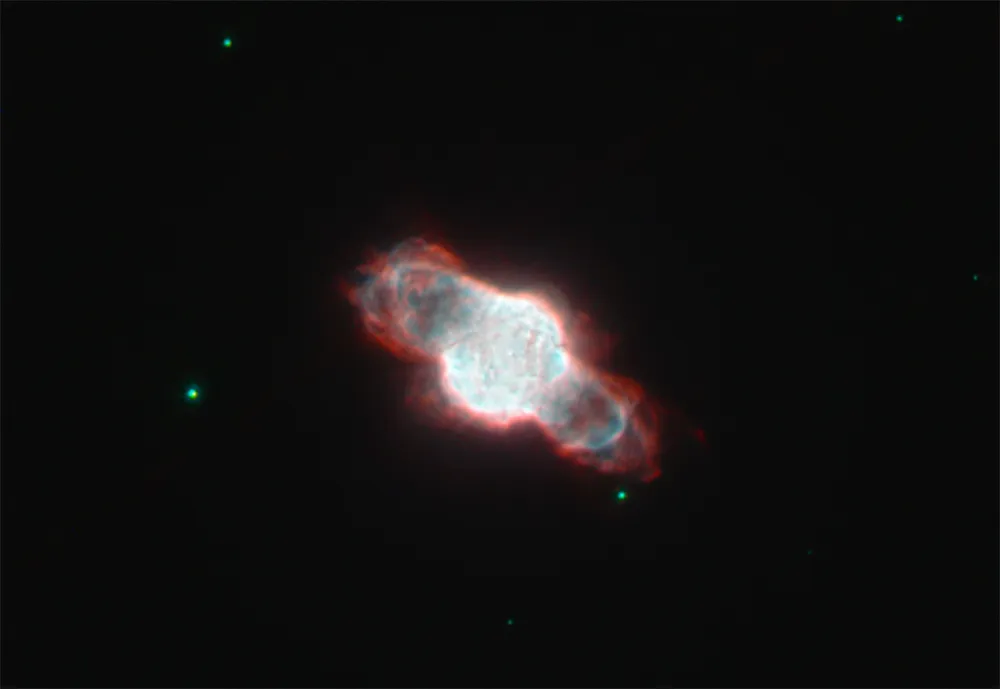
A planetary nebula is an emission nebula formed when a dying, low- or intermediate-mass star sheds its outer layers and its exposed, hot core photoionizes the expelled gas, producing a compact, often ringlike or bipolar glow in optical forbidden lines and hydrogen recombination lines. According to Britannica, the class name arose in the late 1700s from their planet-like disks seen in small telescopes, though the objects are unrelated to planets and end as a White dwarf remnant.
Physical origin and evolution
As a star of roughly 1–8 solar masses ascends the Asymptotic Giant Branch, strong pulsation-driven and dust-accelerated winds remove a substantial fraction of the envelope. When mass loss exposes the hot core, ultraviolet photons ionize the expanding circumstellar shell, creating the planetary nebula; the core evolves toward a White dwarf with a typical mass near 0.6 M⊙. Observed central-star temperatures span roughly 25,000–200,000 K, and the ionized shell survives of order 10,000–30,000 years until it disperses into the interstellar medium, as summarized by Britannica and
Britannica – central stars. Foundational radiative and dynamical processes, including photoionization, recombination, and shock compression by fast winds, are treated in the standard text Astrophysics of Gaseous Nebulae and AGN by Osterbrock and Ferland (
Astrophysics of Gaseous Nebulae and Active Galactic Nuclei; also see book://Osterbrock & Ferland|Astrophysics of Gaseous Nebulae and Active Galactic Nuclei|University Science Books|2006).
Typical bulk expansion speeds measured from low-ionization lines are tens of km s−1, with jets and microstructures reaching higher velocities; compilations and hydrodynamic modeling imply characteristic spectroscopic values ≈10–30 km s−1 and average true expansion rates toward ≈40 km s−1 when model-corrected, while collimated flows can exceed 100 km s−1 (Astronomy & Astrophysics, expansion patterns;
Astronomy & Astrophysics, true expansion rates).
Spectral characteristics
Planetary nebulae exhibit bright recombination lines (Hα, Hβ, He I/II) and collisionally excited “forbidden” lines of heavy elements, notably O III λλ4959, 5007 and N II λ6584, that dominate their optical appearance and diagnostics. Line ratios provide electron temperatures, densities, and ionic abundances; the physics of nebular cooling is governed by collisionally excited lines, as detailed by Osterbrock & Ferland (Astrophysics of Gaseous Nebulae and Active Galactic Nuclei; book://Osterbrock & Ferland|Astrophysics of Gaseous Nebulae and Active Galactic Nuclei|University Science Books|2006). High stages of ionization close to the central star and the wide temperature range of nuclei are emphasized in
Britannica.
Morphology and shaping
Resolved imaging from the Hubble Space Telescope reveals a wide morphological diversity—spherical, elliptical, bipolar, multipolar forms, rings, and low-ionization knots—requiring shaping mechanisms beyond isotropic winds. A comprehensive review argues that interacting stellar winds, magnetic fields, and, increasingly, binary interactions contribute, with no single mechanism explaining all forms (Annual Review of Astronomy and Astrophysics – Balick & Frank). Observational studies link close binary central stars to bipolarity, jets, and equatorial structures, supporting a significant binary role in many systems (e.g.,
arXiv:0907.2463;
arXiv:1111.2860). NASA overviews illustrate the pre-planetary and planetary phases and their complex jets and dust tori (
NASA Science – Hubble’s Nebulae;
NASA Science – planetary nebula in the making).
Distances and the luminosity function
Direct distances are difficult because objects are small and varied; statistical scales and expansion-parallax methods have large uncertainties, though calibrated relations such as the Hα surface brightness–radius (S_{Hα}–r) relation now provide improved statistical distances for large samples (Monthly Notices of the Royal Astronomical Society – S_{Hα}–r). Extragalactically, the Planetary Nebula Luminosity Function (PNLF) built from the O III λ5007 line exhibits a bright-end cutoff used as a secondary standard candle out to ≈20 Mpc, with ongoing work pushing farther and exploring population dependencies (
A&A – M31 bright PNe). Reviews highlight both the method’s robustness and theoretical challenges in old stellar populations (
Proceedings IAU, Ciardullo; see also
arXiv:1203.5551).
Population, sizes, and lifetimes
Within the Milky Way, selection and extinction limit catalogs to roughly 3,500 objects, but the true Galactic population is estimated near 20,000; typical radii are a few tenths of a light‑year, and expansion-age estimates reach ≈30,000 years before the nebula fades into the interstellar background (Britannica). Statistical distance indicators and improved parallaxes continue to refine Galactic distributions and scale heights, while individual systems show velocity fields from ≲30 km s−1 shells to >100 km s−1 jets (
A&A – expansion patterns).
Chemical abundances and galactic role
Planetary nebulae trace nucleosynthesis in low- and intermediate‑mass stars and contribute newly synthesized helium, carbon, and nitrogen to the interstellar medium; abundance patterns (e.g., N/O, C/O, He/H) reflect dredge-up and hot-bottom burning on the AGB. Reviews and large samples show systematic He, C, and N enrichment relative to ISM baselines, while oxygen and other α-elements generally track initial metallicity (MNRAS – Henry et al. 2017;
Frontiers in Astronomy & Space Sciences; also see [A&A 2013, WC nuclei](
https://www.aanda.org/articles/aa/full_html/2013/10/aa22354-13/aa22354-13.html)).
Central stars and remnants
The ionizing nuclei evolve quickly across the HR diagram at nearly constant luminosity before descending the white-dwarf cooling track; mass distributions of central stars peak near 0.6 M⊙, consistent with typical White dwarf masses measured in related contexts (A&A – Gesicki & Zijlstra;
Britannica – central stars). HST-based studies of globular-cluster planetary nebulae find central-star masses ≈0.53–0.58 M⊙, with some objects indicating binary influence (
ApJ 2017 – central star masses).
Historical notes
The descriptive term “planetary nebula” dates to late‑18th‑century observations by William Herschel; the gaseous nature was established in 1864 when William Huggins first observed bright emission lines (e.g., in NGC 6543), distinguishing nebulae from stellar spectra and inaugurating astronomical spectroscopy (Royal Society archives, Huggins 1864; see also NASA’s historical overview of nebula types:
NASA Science – Hubble’s Nebulae).
Observational techniques and applications
Narrowband imaging in O III λ5007, Hα, and N II isolates ionized structures; integral-field spectroscopy resolves kinematics and excitation, and time-baseline imaging enables expansion-parallax distances. The S_{Hα}–r relation now underpins large uniform Galactic distance compilations, while the Planetary Nebula Luminosity Function provides extragalactic distances. In addition, discrete planetary-nebula velocities trace galaxy halos where starlight is too faint: the Planetary Nebula Spectrograph has measured outer-halo kinematics of early-type galaxies, constraining dark-matter distributions and stimulating debate about mass profiles (MNRAS – PN.S overview;
Science 2003 – Romanowsky et al.;
MNRAS 2016 – MOND analysis).
Reference works
Concise encyclopedic treatments and classic monographs synthesize the field, including Britannica; Osterbrock & Ferland’s graduate text (book://Osterbrock & Ferland|Astrophysics of Gaseous Nebulae and Active Galactic Nuclei|University Science Books|2006); and Sun Kwok’s comprehensive treatment of formation and evolution (
Cambridge University Press page; also book://Sun Kwok|The Origin and Evolution of Planetary Nebulae|Cambridge University Press|2000).