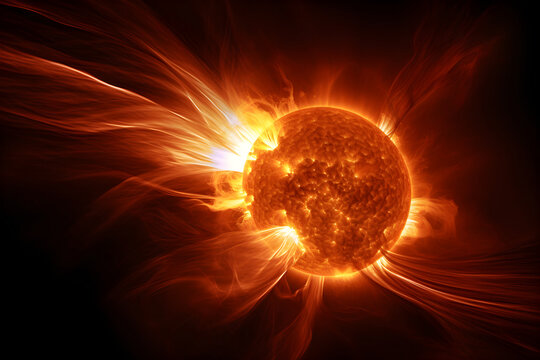
A solar flare is an abrupt, powerful burst of radiation from the Sun produced by the rapid release of magnetic energy in active regions near sunspots, emitting across the electromagnetic spectrum from radio waves to gamma rays on timescales of minutes to hours. According to NASA Science, large flares can rival a billion hydrogen bombs in energy and their radiation reaches Earth at light speed in about eight minutes.
Physical mechanism and emissions
Flares originate where highly stressed coronal magnetic fields undergo magnetic reconnection, converting stored magnetic energy into plasma heating, particle acceleration, and radiation observable from radio to gamma rays, as reviewed by Shibata & Magara (Living Reviews in Solar Physics, 2011). The global energetics of major events approach 10^32 erg (10^25 joules), with radiant energy and associated mass motions often comparable in scale, as summarized by
Hudson (Space Science Reviews, 2011). Observationally, flares heat coronal plasma to tens of millions of kelvin and accelerate electrons and ions that produce hard X‑ray and gamma‑ray signatures, consistent with RHESSI‑era syntheses such as
Fletcher et al. (Space Science Reviews, 2011). High‑energy gamma rays up to multi‑GeV have been detected during strong events, confirming efficient particle acceleration, as documented by
NASA’s Fermi mission report.
Observation, classification, and measurement
Spaceborne sensors continuously monitor soft X‑ray flux to detect and classify flares, with NOAA’s GOES X‑Ray Sensor (XRS) defining the A, B, C, M, and X classes by peak 0.1–0.8 nm flux at Earth, each letter a ten‑fold step in intensity and a number scaling within the class, as specified in the NOAA SWPC glossary. The GOES‑R EXIS and legacy XRS instruments provide operational irradiance used for alerts, with product descriptions and band definitions detailed by
NOAA/NCEI and
GOES‑R Program documentation. Imaging from instruments such as the Solar Dynamics Observatory’s AIA complements irradiance data by locating and characterizing flare structures, as described by
NASA/SDO. Because flare X‑rays arrive first, they are often the earliest indicator of eruptive activity affecting geospace, a use case emphasized in
NOAA SWPC’s Solar X‑ray Imager overview.
Relation to the solar cycle and active regions
Flares occur most frequently in magnetically complex active regions and their incidence varies with the approximately 11‑year Solar cycle, with maxima producing more frequent and energetic events, as outlined by NASA Science and reviews of flare‑productive regions such as
Toriumi & Wang (Living Reviews in Solar Physics, 2019). Many large flares are temporally associated with Coronal mass ejection eruptions, though either phenomenon can occur without the other, and their physical coupling is an active research area summarized in
Hudson (2011).
Effects on Earth and technological systems
Flares can cause immediate radio‑communication disturbances on the sunlit side of Earth by increasing ionospheric absorption ("radio blackouts"), which NOAA categorizes from R1 (minor) to R5 (extreme) based on GOES soft X‑ray peak flux, with expected impacts to HF radio and some navigation signals specified on the NOAA Space Weather Scales. Flares and associated eruptions can also enhance radiation hazards to spacecraft and astronauts and contribute to broader Space weather impacts alongside CME‑driven Geomagnetic storms, with public‑facing explanations provided by
NOAA and operational model descriptions at
SWPC. Although intense, flare radiation is not harmful at the surface due to atmospheric shielding, a point emphasized in multiple
NASA event summaries.
Notable events and records
The most powerful soft X‑ray flare measured in the satellite era occurred on 2003‑11‑04 and saturated GOES detectors; subsequent analyses estimated a peak intensity near X28, establishing a modern record, with context provided by the European Space Agency and quantitative reconstruction discussed by
Brodrick et al., Journal of Geophysical Research (2005). The first reported "white‑light" flare was observed on 1859‑09‑01 by Richard Carrington, preceding the severe geomagnetic storm of 1859, commonly known as the Carrington Event, as summarized by
Encyclopaedia Britannica. During Solar Cycle 25, multiple X‑class flares have been recorded, including large events in 2024, illustrating ongoing cycle‑phase activity as noted by
NASA Science coverage.
Diagnostics across wavelengths
Soft X‑ray and EUV diagnostics trace hot coronal plasma and flare loops, while hard X‑rays and gamma rays reveal nonthermal particles and nuclear interactions, integrating into standard flare models that include thick‑target bremsstrahlung and energy transport to the chromosphere, as synthesized by Fletcher et al. (2011). High‑energy observations with Fermi and RHESSI demonstrate long‑lasting gamma‑ray emission and sub‑second hard X‑ray variability tied to particle acceleration episodes, with examples in
NASA’s Fermi report and statistical hard X‑ray studies such as
A&A analyses of RHESSI spikes.
Monitoring and forecasting
Operational monitoring blends irradiance measurements, imagery, and modeling to issue watches, warnings, and alerts for radio blackouts (R‑scale), solar radiation storms (S‑scale), and geomagnetic storms (G‑scale), with product definitions and typical impacts maintained by NOAA SWPC. Continuous soft X‑ray flux from GOES EXIS/XRS underpins flare detection and classification used by forecasters and researchers, as described in
NOAA/NCEI EXIS documentation and
GOES‑R X‑ray flux product notes, while model overviews are outlined by
SWPC.
Historical context
Carrington’s 1859 white‑light flare observation and the near‑coincident storm provided early evidence of solar–terrestrial coupling that evolved into modern space‑weather research, with authoritative histories and impacts summarized by Encyclopaedia Britannica. The observational record since the 1970s has established standardized soft X‑ray classification and multi‑wavelength diagnostics that remain foundational to present‑day flare science and forecasting, as reflected in NOAA’s classification scheme and NASA mission documentation (
NOAA SWPC glossary;
NASA/SDO).
Sunspot active regions, the Solar cycle, Coronal mass ejection eruptions, Earth’s Magnetosphere, and the broader domain of Space weather are common cross‑references for contextualizing flare occurrence and impacts, with each topic covered in specialized literature and operational resources cited above (NASA Science; NOAA SWPC).