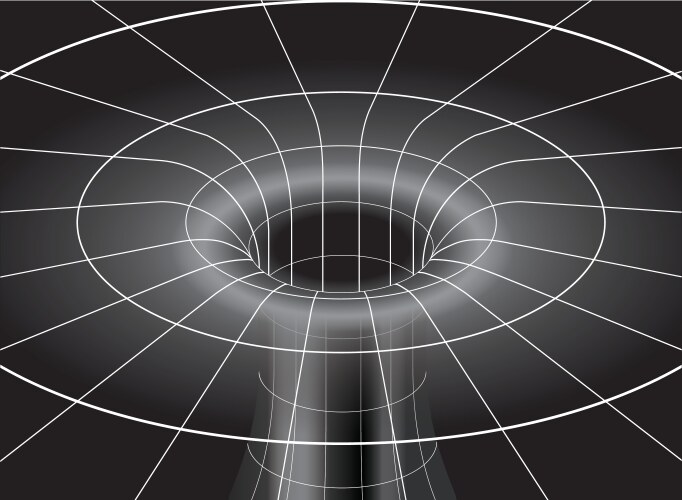
Spacetime is a four‑dimensional continuum combining three spatial dimensions with time into a single geometric entity used to describe physical events in modern physics; in special relativity it is flat (Minkowski space), and in general relativity it is a curved Lorentzian manifold in which gravity manifests as geometry. Authoritative overviews emphasize the four‑dimensional structure and the role of the invariant speed of light c = 299,792,458 m/s, fixed by the SI definition of the metre. Britannica;
Encyclopedia of Mathematics;
NIST. (
britannica.com)
Definition and mathematical structure
Spacetime points (“events”) are labeled by one time coordinate and three spatial coordinates; the separation between two events is encoded by the spacetime interval. In special relativity, Minkowski introduced a pseudo‑Euclidean metric with interval s² = c²Δt² − Δx² − Δy² − Δz² (signature conventions vary), whose invariance under Lorentz transformations reflects the relativity of space and time and the constancy of c. Encyclopedia of Mathematics;
Britannica – Lorentz transformations. (
encyclopediaofmath.org)
Mathematically, general spacetime is modeled as a differentiable manifold equipped with a Lorentzian metric; curvature derived from this metric (via the Riemann and Ricci tensors and scalar curvature) encodes gravitational phenomena. Introductory accounts of manifolds and their role in relativity are widely available. Britannica – manifold. (
britannica.com)
Historical development
Classical mechanics treated space and time as absolute and separate, an approach displaced by Albert Einstein’s 1905 special relativity and Hermann Minkowski’s 1908 spacetime formulation. Minkowski’s Cologne lecture famously unified space and time into a single four‑dimensional structure. Readable historical sources include English translations of Minkowski’s “Space and Time” and Einstein’s popular monograph. Minkowski Institute;
Project Gutenberg – Einstein, Relativity. (
minkowskiinstitute.org)
In 1915 Einstein presented the field equations of General relativity, relating spacetime curvature to stress–energy; standard summaries and historical notes appear in reference entries on the Einstein field equations and general relativity. Britannica – General relativity;
Einstein field equations. (
britannica.com)
Special relativity in spacetime
In flat (Minkowski) spacetime, inertial observers are related by Lorentz transformations; time dilation and length contraction arise from the geometry of the interval. A clock moving at speed v is observed to tick slower by a factor √(1−v²/c²), and simultaneity is frame‑dependent. Authoritative encyclopedic treatments explain these kinematic effects without coordinates. Britannica – time dilation;
Britannica – Lorentz transformations;
NIST on exact c. (
britannica.com)
Causal structure is depicted with light cones that separate timelike, lightlike (null), and spacelike intervals; worldlines remain within their future light cones. Expositions of light cones and causal relations clarify how curvature deforms cone orientation. Stanford Encyclopedia of Philosophy – Light Cones and Causal Structure;
Spacetime diagram. (
plato.stanford.edu)
General relativity and curvature
Einstein’s field equations relate geometry and matter via
G_{μν} + Λ g_{μν} = (8πG/c^4) T_{μν},
so that mass–energy curves spacetime and freely falling bodies follow geodesics in that curved geometry. Concise reference entries and standard graduate texts develop the geometric formulation and its consequences. Britannica – General relativity;
Einstein field equations; [Gravitation](book://Charles W. Misner; Kip S. Thorne; John A. Wheeler|Gravitation|W. H. Freeman|1973); [Wald, General Relativity](book://Robert M. Wald|General Relativity|University of Chicago Press|1984); [Carroll, Spacetime and Geometry](book://Sean M. Carroll|Spacetime and Geometry: An Introduction to General Relativity|Cambridge University Press|2019). (
britannica.com)
Proper time along a timelike worldline is the invariant “arc length” of that curve in spacetime; it governs physical clock readings and distinguishes timelike from null and spacelike separations. Proper time. (
en.wikipedia.org)
Empirical tests and measurements
- –Perihelion advance of Mercury is explained by spacetime curvature near the Sun, matching observations that Newtonian gravity could not.
Britannica – perihelion (relativity). (
- –1919 eclipse expeditions led by Eddington and Dyson measured the deflection of starlight by the Sun, supporting general relativity.
- –Gravitational redshift was measured on Earth in the Pound–Rebka experiment (1959–60); radar ranging near the Sun confirmed the Shapiro time delay.
Pound–Rebka;
- –Direct detection of Gravitational wave signals by LIGO/Virgo beginning with GW150914 (observed 2015; announced 2016) validates the propagation of curvature perturbations predicted by general relativity.
arXiv/PRL discovery paper. (
- –Everyday technology relies on relativistic spacetime: GPS satellite clocks run faster by about +45 μs/day from gravitational redshift and slower by about −7 μs/day from kinematic time dilation; the net +38 μs/day is corrected in system design.
NIST. (
Cosmological spacetimes
On the largest scales the Universe is modeled by Friedmann–Lemaître–Robertson–Walker (FLRW) spacetimes, whose dynamics fit observations of the cosmic microwave background (CMB) and large‑scale structure. Space missions such as WMAP and Planck mapped CMB anisotropies with high precision, constraining geometry and contents. Planck (ESA) overview;
CMB;
Britannica – cosmology (relativistic models). (
en.wikipedia.org)
Observations of distant Type Ia supernovae in 1998 indicated that cosmic expansion is accelerating, a result recognized by the 2011 Nobel Prize in Physics and commonly modeled by a positive cosmological constant or dark energy. Nobel Prize press release. Contemporary work continues to test the cosmological model, including “Hubble tension” results that compare late‑ and early‑Universe inferences of the expansion rate.
Reuters – JWST/Hubble tension update (Dec. 9, 2024). (
nobelprize.org)
Concepts and tools
- –Special relativity and Lorentz transformation symmetries (Poincaré invariance) characterize flat spacetime physics and underlie the classification of intervals and causal orderings.
- –Light cones, worldlines, and proper time quantify causality and clock readings; Penrose diagrams and global hyperbolicity address global causal structure.
Stanford Encyclopedia of Philosophy – Light Cones and Causal Structure. (
- –Textbooks and monographs standardize notation and techniques (metric signatures, geodesics, curvature, energy conditions) used across gravitational physics. [Gravitation](book://Charles W. Misner; Kip S. Thorne; John A. Wheeler|Gravitation|W. H. Freeman|1973); [Wald, General Relativity](book://Robert M. Wald|General Relativity|University of Chicago Press|1984); [Carroll, Spacetime and Geometry](book://Sean M. Carroll|Spacetime and Geometry: An Introduction to General Relativity|Cambridge University Press|2019).
Primary sources and classic texts
Minkowski’s 1908 lecture introduced the spacetime viewpoint to physics; Einstein’s 1916 expository book and his field‑equation papers remain primary references in translation. Minkowski Institute;
Project Gutenberg – Einstein;
Einstein field equations overview. (
minkowskiinstitute.org)