Definition and etymology
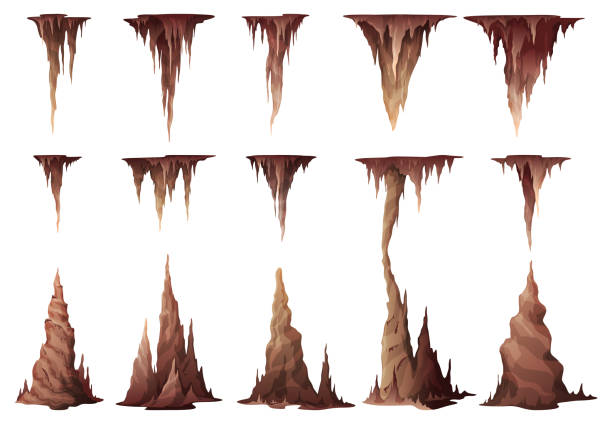
A stalagmite is a convex, floor-mounted cave deposit that accumulates from successive drips of mineral-rich water, typically forming rounded or conical mounds that “might” reach the ceiling to form a column with a counterpart Stalactite. According to the U.S. National Park Service, stalagmites lack the hollow central tube common in some stalactites and are usually broader with rounded tops; the term derives from Greek for “that which drops.” National Park Service,
Encyclopaedia Britannica.
Mineralogy and occurrence
Most stalagmites are speleothems made of calcite, the calcium carbonate polymorph that predominates in limestone caves, though aragonite (a polymorph of calcite) and gypsum deposits also occur. U.S. Geological Survey materials note that calcite dominates but aragonite and gypsum are present in many cave systems, including in and around Carlsbad Caverns National Park. U.S. Geological Survey,
U.S. Geological Survey. Stalagmites are most abundant in limestone and dolomite caves within Karst terrains where percolating water supplies dissolved carbonate to cave air spaces.
Encyclopaedia Britannica.
Formation chemistry
The chemistry of stalagmite growth is the reverse of limestone dissolution. Near the surface and within soils, water absorbs carbon dioxide to form carbonic acid (H2CO3), which dissolves calcite as calcium bicarbonate in solution (Ca2+ and HCO3−). Upon entering a cave’s air-filled voids, carbon dioxide degasses and/or water evaporates, driving precipitation of solid CaCO3 on cave floors where drips land. The sequence is commonly summarized by the reactions: H2O + CO2 → H2CO3; CaCO3 + H2CO3 → Ca2+ + 2HCO3−; then Ca2+ + 2HCO3− → CaCO3 + CO2 + H2O. National Park Service. Thermodynamic studies and measurements of the relative stabilities of calcite and aragonite in CO2–H2O systems underpin expectations for which polymorph precipitates under given conditions.
U.S. Geological Survey,
U.S. Geological Survey.
Growth and morphology
Drip rate and degassing/evaporation control how carbonate is partitioned between ceiling and floor: slow dripping favors stalactite growth with fewer solids reaching the floor, while faster dripping can shift deposition to the floor and build a stalagmite; extremely rapid flow can pond and inhibit stalagmite formation. A commonly cited order-of-magnitude estimate for dripstone accumulation is about one cubic inch of deposit per century, though rates vary widely with chemistry, temperature, and water supply. Kentucky Geological Survey. Because falling droplets splash, stalagmites tend to broaden and lack central tubes; with continued growth, opposing stalactite and stalagmite can join to form a column.
National Park Service. In detail, stalagmites display laminae and bands recording interruptions or shifts in growth, reflecting variability in drip hydrology and cave microclimate.
Kentucky Geological Survey.
Variants and materials
While the canonical stalagmite is calcitic, caves also host non-carbonate stalagmites, notably gypsum where sulfate-rich waters evaporate under dry cave conditions. Kentucky Geological Survey,
National Park Service. In volcanic Lava tube caves, molten drips can freeze into “lavacicles” on ceilings and pancake-like mounds on floors, creating stalagmite-like lava deposits that form rapidly while lava is active.
National Park Service,
U.S. Geological Survey.
Scientific applications
Stalagmites are archives of environmental change because their chemistry and textures are time-ordered along growth axes. Oxygen-isotope ratios (δ18O) and carbon-isotope ratios (δ13C) in stalagmite calcite record changes in moisture source, rainfall amount, cave temperature, soil CO2, and prior calcite precipitation, with interpretations calibrated to regional hydroclimate. National Centers for Environmental Information (NOAA),
National Centers for Environmental Information (NOAA). High-precision Uranium–thorium dating provides absolute chronologies for calcitic stalagmites typically up to roughly 500–650 thousand years under favorable conditions, enabling alignment of stalagmite proxy records with glacial–interglacial climate cycles.
Geochronology (EGU),
Elements journal (University of Minnesota summary). When older ages are needed or when U–Th is not applicable, U–Pb or (U,Th)–He methods on suitable carbonates can extend age control further back in time, albeit with different constraints.
Geochronology (EGU),
PubMed. NOAA’s global speleothem data holdings illustrate the breadth of stalagmite-based paleoclimate reconstructions from the Quaternary period to recent centuries.
National Centers for Environmental Information (NOAA),
National Centers for Environmental Information (NOAA).
Notable localities
In the Guadalupe Mountains of New Mexico, caves in and around Carlsbad Caverns National Park contain extensive calcite stalagmites that largely formed under wetter late Pleistocene conditions; the caves themselves were dissolved predominantly by sulfuric acid, but the later speleothems formed by carbonic-acid processes. U.S. Geological Survey. Other major cave systems, such as Mammoth Cave in Kentucky, showcase zones rich in dripstone and gypsum, reflecting spatial contrasts in moisture and mineral supply.
National Park Service,
Kentucky Geological Survey.
Conservation and sensitivity
Stalagmites are fragile and grow slowly; oils from touch and physical impacts can alter wetting behavior and break or halt growth. Park guidance emphasizes avoiding contact and protecting cave microclimates to preserve active deposition and surface integrity. National Park Service. In arid cave systems, decreased humidity can dissolve or desiccate sulfate features, demonstrating the sensitivity of non-carbonate stalagmites and related speleothems to ventilation and climate variability.
National Park Service.
Further reading (selected)
- –[Speleothem Science](book://Ian J. Fairchild|Speleothem Science: From Process to Past Environments|Wiley-Blackwell|2012) — comprehensive treatment of speleothem formation, geochemistry, and paleoclimate applications.
- –[Encyclopedia of Caves](book://William B. White & David C. Culver|Encyclopedia of Caves (3rd ed.)|Academic Press|2019) — overview of speleothem types and cave processes.