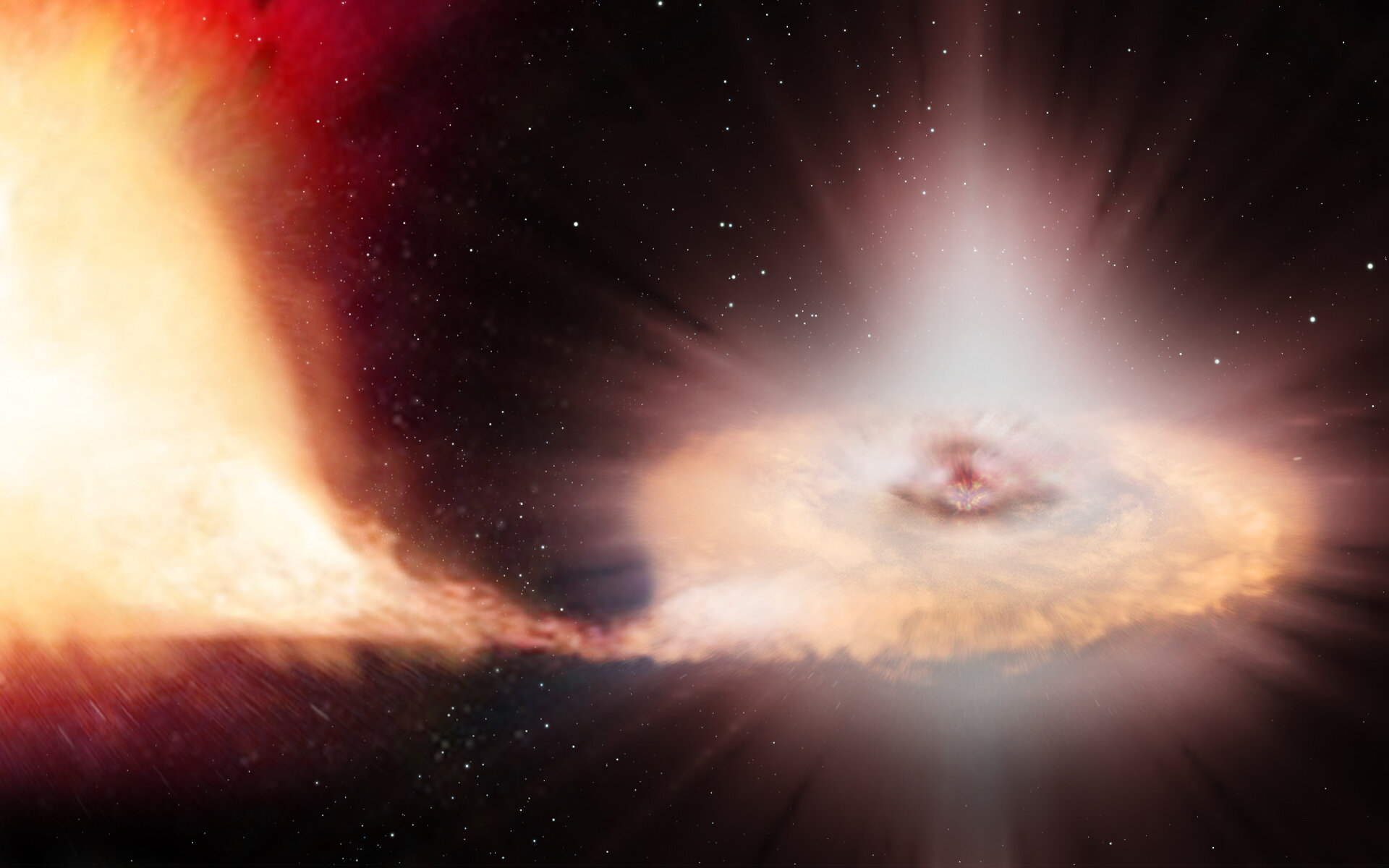
Type Ia supernovae are thermonuclear explosions of carbon–oxygen White dwarf stars in binaries, used as standardized candles for extragalactic distance measurements and cosmology. Type Ia Supernova Explosion Models
SALT2: using distant supernovae to improve the use of type Ia supernovae as distance indicators
The 2011 Nobel Prize in Physics – press release.
Classification and defining features
Type Ia supernovae are identified spectroscopically by the lack of hydrogen lines (distinguishing Type I from Type II) and the presence, near maximum light, of a strong Si II absorption feature with a rest wavelength near 6355 Å, together with late-time spectra dominated by iron-group emission lines. OPTICAL SPECTRA OF SUPERNOVAE
On spectral line profiles in Type Ia supernova spectra.
They occur in all major galaxy types, including ellipticals, consistent with origins in long-lived stellar populations.
Type Ia Supernovae as Standard Candles
On the environments of Type Ia supernovae within host galaxies.
Typical photospheric-line velocities around maximum are roughly 9,000–15,000 km s⁻¹, with additional high‑velocity components sometimes observed in Ca II and Si II at earlier phases.
OPTICAL SPECTRA OF SUPERNOVAE
High-Velocity Features in Type Ia Supernova Spectra
High-Velocity Features of Calcium and Silicon in the Spectra of Type Ia Supernovae.
Physical mechanism
Type Ia events result from a thermonuclear runaway that incinerates a degenerate carbon–oxygen core, synthesizing large amounts of iron-group nuclei, with the radioactive decay chain 56Ni → 56Co → 56Fe powering the light curve for weeks to months. Nucleosynthesis in thermonuclear supernovae
Type I supernovae. I. Analytic solutions for the early part of the light curve
Type Ia Supernovae as Standard Candles.
Nickel-56 yields typically span ~0.3–0.8 M☉ across normal luminosity events, reflecting variations in burning conditions and ejecta mass.
Nucleosynthesis in thermonuclear supernovae.
Progenitor and explosion scenarios
Two broad progenitor channels are supported by observations and modeling: the single‑degenerate channel, where a white dwarf accretes from a non‑degenerate companion, and the double‑degenerate channel, involving the merger of two white dwarfs. Observational Clues to the Progenitors of Type Ia Supernovae.
Explosion mechanisms include near‑Chandrasekhar mass deflagration–detonation transitions, violent mergers, and sub‑Chandrasekhar “double detonations” in which a helium‑shell detonation triggers a secondary core detonation.
Type Ia Supernova Explosion Models
Non‑LTE radiative transfer simulations: improved agreement of the double detonation with normal Type Ia supernovae
On the fate of the secondary white dwarf in double‑degenerate double‑detonation Type Ia supernovae.
The delay‑time distribution inferred from rates follows an approximate t⁻¹ form from hundreds of Myr to several Gyr, consistent with a significant contribution from merging white dwarfs.
The delay‑time distribution of type‑Ia supernovae from Sloan II
Type‑Ia Supernova Rates and the Progenitor Problem: A Review.
Light curves, standardization, and the Phillips relation
Although unstandardized peak luminosities show intrinsic scatter, a tight empirical relation links peak brightness to post‑maximum decline rate (the Phillips relation), enabling standardization of distances. The Absolute Magnitudes of Type IA Supernovae
The Absolute Luminosities of the Calán/Tololo Type Ia Supernovae.
Modern light‑curve fitters such as SALT/SALT2 model color and stretch to achieve distance precisions at the ~0.1–0.15 mag level per object in large samples.
SALT
SALT2: using distant supernovae to improve the use of type Ia supernovae as distance indicators.
Host‑galaxy correlations, notably a “mass step” wherein SNe Ia in higher‑mass or lower‑sSFR galaxies are slightly brighter after standardization, are now commonly modeled in cosmological analyses.
The dependence of Type Ia Supernovae luminosities on their host galaxies
First cosmology results using type Ia supernovae from the Dark Energy Survey: the effect of host galaxy properties.
Cosmological applications
Type Ia supernovae underpin the Cosmic distance ladder, and high‑redshift samples revealed that distant events are dimmer than expected in decelerating models, implying cosmic acceleration. Observational Evidence from Supernovae for an Accelerating Universe and a Cosmological Constant
Measurements of Ω and Λ from 42 High‑Redshift Supernovae.
The discovery of the accelerating expansion using SNe Ia was recognized with the 2011 Nobel Prize in Physics.
The 2011 Nobel Prize in Physics – press release.
Contemporary compilations, such as Pantheon+, combine 1500+ SNe Ia over 0 < z ≲ 2.3 to constrain the matter density and the dark‑energy equation‑of‑state, finding results consistent with a cosmological constant when combined with CMB and BAO.
The Pantheon+ Analysis: Cosmological Constraints.
Diversity and notable subtypes
Diversity spans overluminous, slowly declining 1991T‑like events with prominent pre‑maximum Fe III and weak Si II, to subluminous, rapidly declining 1991bg‑like events with strong Ti II features and low 56Ni yields. On the spectrum and nature of the peculiar Type Ia supernova 1991T
SN 1991bg: A type Ia supernova with a difference
Nebular spectra of the Type Ia supernova 1991bg: further evidence of a non‑standard explosion.
Some SNe Ia display early high‑velocity absorption components or circumstellar interaction signatures, indicating diversity in ejecta structure and environments.
High-Velocity Features in Type Ia Supernova Spectra
Rising light curves of Type Ia supernovae.
A related class, Type Iax, shows lower ejecta velocities and can leave a bound remnant, underscoring diversity in thermonuclear outcomes.
NASA’s Hubble finds supernova star system linked to potential ‘zombie star’.
Rates and occurrence
In the Milky Way, Type Ia supernovae are estimated to occur roughly once per few centuries, consistent with their origin in older stellar populations relative to core‑collapse events. Type Ia Supernovae – NASA Science
Type‑Ia Supernova Rates and the Progenitor Problem: A Review.
Empirical delay‑time distributions derived from field and cluster samples support a broad range of delays with an approximate t⁻¹ behavior.
The delay‑time distribution of type‑Ia supernovae from Sloan II
Observational Clues to the Progenitors of Type Ia Supernovae.
Observation and analysis
Standard practice uses multi‑band photometry and Spectroscopy to fit light‑curve parameters and measure redshifts, with corrections for color, stretch, and host properties to infer distances. SALT2: using distant supernovae to improve the use of type Ia supernovae as distance indicators
Hubble measures the distance to a supernova.
Space‑ and ground‑based surveys continue to expand samples and refine calibrations for measurements of the Hubble constant and Dark energy.
The Pantheon+ Analysis: Cosmological Constraints
Type Ia Supernovae – NASA Science.