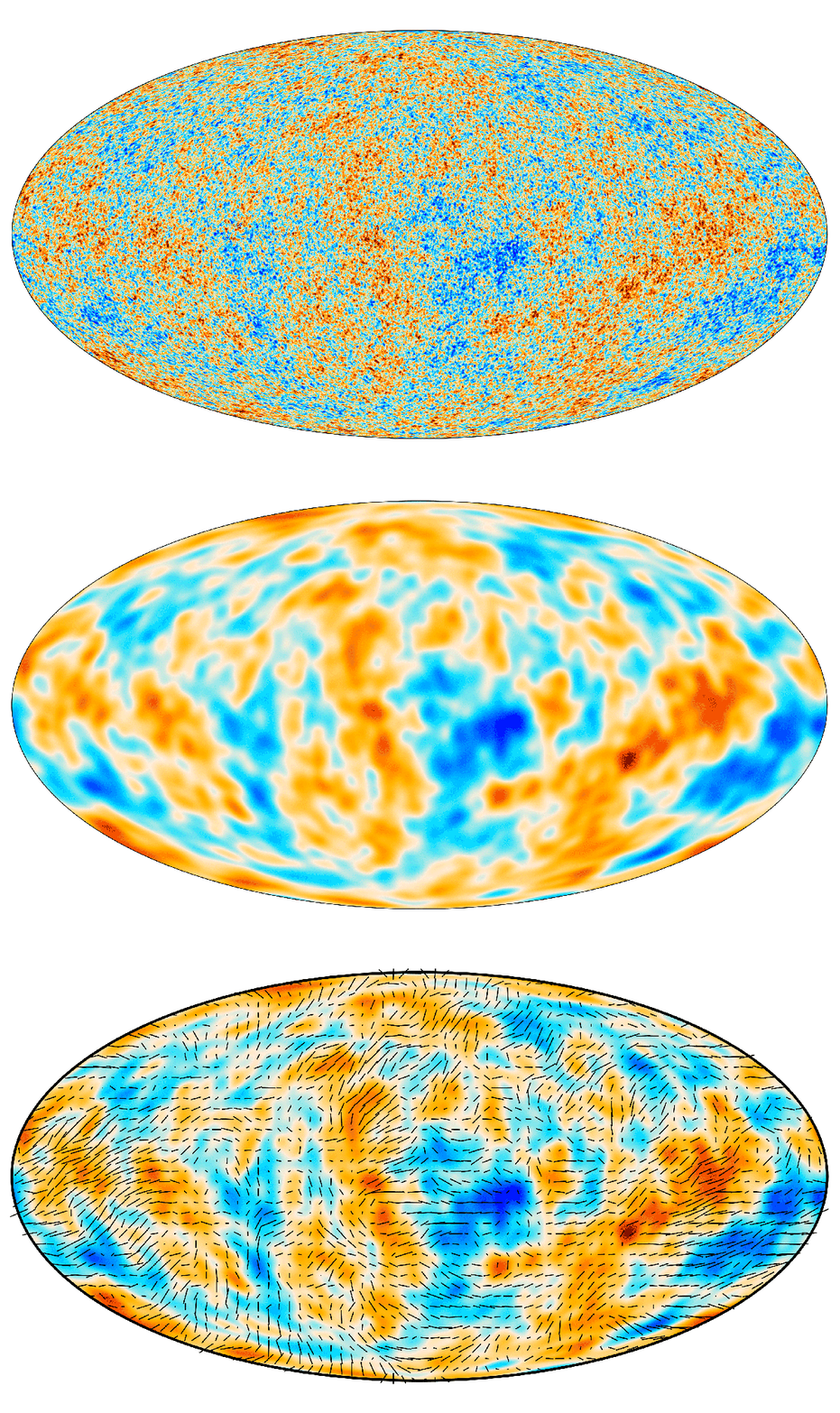
The cosmic microwave background (CMB) is the relic radiation from the hot early universe, observed today as an almost perfectly isotropic blackbody with a mean temperature of about 2.725 K, filling all directions of the sky and providing key evidence for the Big Bang model of cosmology (NASA LAMBDA;
A&A—Planck 2018).
Physical origin and spectrum
The CMB photons last scattered when the universe cooled enough for electrons and protons to form neutral hydrogen—“recombination”—ending the tight coupling between matter and radiation and releasing photons to free-stream from a surface of last scattering at redshift z ≈ 1100, about 380,000 years after the Big Bang (book://Steven Weinberg|Cosmology|Oxford University Press|2008; journal://Astrophysical Journal|RECOMBINATION OF THE PRIMEVAL PLASMA|1968). The CMB spectrum is an exceptionally precise blackbody; COBE’s FIRAS instrument found deviations smaller than a few parts in 10^5 and a temperature near 2.725 K, establishing the thermal origin of the radiation (NASA NTRS;
NASA LAMBDA). A comprehensive analysis of FIRAS data and later recalibration yielded T0 = 2.72548 ± 0.00057 K (
arXiv:0911.1955).
Discovery and early interpretation
In 1965, Arno A. Penzias and Robert W. Wilson reported an isotropic excess antenna temperature of ~3.5 K at 4080 MHz, which they could not attribute to instrumental or local sources; in a companion letter, R. H. Dicke, P. J. E. Peebles, P. G. Roll, and D. T. Wilkinson interpreted the signal as relic radiation from the hot Big Bang (journal://Astrophysical Journal|A Measurement of Excess Antenna Temperature at 4080 Mc/s|1965; journal://Physical Review Letters|Cosmic Black-Body Radiation|1965). The detection rapidly transformed cosmology into a precision, testable science (The Guardian).
Temperature anisotropies and acoustic peaks
Although nearly uniform, the CMB exhibits temperature anisotropies at the ~10⁻⁵ level. COBE’s DMR first detected large-angle anisotropies in 1992, confirming predictions of primordial fluctuations (journal://Astrophysical Journal Letters|Structure in the COBE differential microwave radiometer first-year maps|1992; NASA LAMBDA bibliography). On smaller angular scales, a series of peaks in the angular power spectrum—acoustic peaks—arise from sound waves in the photon–baryon fluid before recombination, with the first peak near one degree indicating spatial flatness (book://Scott Dodelson & Fabian Schmidt|Modern Cosmology (2nd ed.)|Academic Press|2020;
Annual Reviews—Hu & Dodelson). The Wilkinson Microwave Anisotropy Probe mapped anisotropies over nine years, constraining key parameters and confirming a nearly scale-invariant spectrum of primordial fluctuations (
OSTI—WMAP cosmological results;
WMAP nine-year summary).
Polarization: E- and B-modes
Thomson scattering at last scattering also imprints linear polarization. The anisotropic radiation field generates a curl-free E-mode pattern and, in principle, a divergence-free B-mode pattern sourced by primordial gravitational waves or by gravitational lensing of E-modes. The first detection of CMB polarization (E-modes and TE correlation) was made by DASI in 2002 (journal://Nature|Detection of polarization in the cosmic microwave background using DASI|2002; arXiv). Lensing B-modes have since been mapped with high significance using combinations of CMB temperature/polarization and lensing reconstructions, including from Planck (
Planck Legacy Archive—lensing B-modes;
OSTI—Planck 2018 lensing). Current upper limits on primordial B-modes imply a tensor-to-scalar ratio r below a few percent, e.g., r < 0.032–0.036 from Planck+BK18, with independent analyses reaching r < 0.028 (95% CL), significantly constraining inflationary models (
OSTI—Phys. Rev. D 105 (2022);
JHEP/JCAP summaries).
The CMB dipole and our motion
The largest CMB feature is a dipole anisotropy produced by our motion with respect to the CMB rest frame. Planck measured a Solar System barycentric velocity of v = 369.82 ± 0.11 km s⁻¹ toward Galactic coordinates (ℓ ≈ 264°, b ≈ 48°), with extremely small directional uncertainty (A&A—Planck overview). Independent analyses of modulation/aberration in Planck maps confirm this motion and its direction (
arXiv).
Precision cosmology from Planck
The [Planck (spacecraft)] all-sky temperature and polarization maps, combined with lensing, yielded the most precise ΛCDM constraints to date. Assuming six-parameter flat ΛCDM, Planck finds H0 = 67.4 ± 0.5 km s⁻¹ Mpc⁻¹, Ωm = 0.315 ± 0.007, σ8 = 0.811 ± 0.006, and ns = 0.965 ± 0.004; the reionization optical depth is τ ≈ 0.054 ± 0.007 (A&A—Planck 2018 VI;
UCL author copy;
IAC summary). These results are consistent with a spatially flat universe and adiabatic, nearly Gaussian initial fluctuations, and are in mild-to-moderate tension with some late-universe measurements of the Hubble constant (A&A—Planck 2018 VI, discussion).
Foregrounds and systematics
Accurate CMB inference requires separation of Galactic and extragalactic foregrounds. Thermal dust emission dominates polarized sky maps above ~100 GHz and exhibits significant E/B asymmetry and spatial complexity; Planck’s 353 GHz polarization maps quantified dust fractions as high as ~20% in some regions and showed that no high-latitude field is entirely free of dust contamination for primordial B-mode searches (A&A—Planck Int. XIX;
A&A—Planck Int. XXX). The re-assessment of the BICEP2 claim illustrated the necessity of multi-frequency component separation to control dust systematics (
Wired overview).
Secondary anisotropies and later imprints
After recombination, CMB photons are gravitationally redshifted (Sachs–Wolfe/ISW effects), gravitationally lensed by large-scale structure, and Compton up-scattered by hot electrons in galaxy clusters, producing the Sunyaev–Zel’dovich (SZ) effect. The SZ effect has become a primary tool for cluster cosmology, complementing CMB primary anisotropies in constraining structure growth and cosmological parameters (book://John E. Carlstrom et al.|Cosmology with the Sunyaev–Zel’dovich Effect|Annual Reviews|2002; NRAO SZ primer).
Space missions and instrumentation
COBE (launched 1989) established the blackbody spectrum (FIRAS) and discovered large-angle anisotropies (DMR), for which J. C. Mather and G. F. Smoot shared the 2006 Nobel Prize (journal://Astrophysical Journal|A preliminary measurement of the CMB spectrum by COBE|1990; COBE overview). WMAP (2001–2010) mapped the full sky with degree-scale resolution and characterized the first acoustic peak and beyond, cementing the six-parameter ΛCDM paradigm (
OSTI;
NASA LAMBDA WMAP papers). Planck (2009–2013) increased angular resolution and frequency coverage, enabling high-precision temperature and polarization spectra, a 40σ detection of lensing, and detailed Galactic foreground maps (
NASA JPL;
A&A—Planck 2018 lensing).
The CMB in structure formation theory
The photon–baryon acoustic oscillations that generate CMB peaks also seeded the Baryon acoustic oscillations standard ruler in the late-time matter distribution, linking CMB constraints with galaxy surveys and precision distance-scale measurements (book://Scott Dodelson & Fabian Schmidt|Modern Cosmology (2nd ed.)|Academic Press|2020; Annual Reviews—Hu & Dodelson). Within General relativity, the CMB provides a self-consistent snapshot of the early universe that, when combined with low-redshift probes, sharply tests models of dark matter, dark energy, neutrino physics, and inflation (A&A—Planck 2018 VI results and extensions).